%20--%3e%3cdefs%3e%3cstyle%3e%20.st0%20{%20fill:%20%23fff;%20}%20%3c/style%3e%3c/defs%3e%3cpath%20class='st0'%20d='M37.06,124.64c1.42-.39,3.06.14,4.14.77,29.56,17.44,67.54,6.48,83.47-23.79,9.31-17.68,10.16-36.97,1.54-55.34-1.29-2.76.63-5.66,3.07-6.48,2.76-.91,5.34.33,6.56,2.99,7.71,16.78,8.53,35.39,2.51,52.8-14.32,41.46-61.44,61.08-100.66,39.6l-28.54,8.18c-1.53.44-3.51-.85-4.32-1.78-1.07-1.23-1.51-2.99-1.06-4.68l7.42-27.48C1.75,93.06-1.86,75.29,2.43,56.85,9.85,24.85,36.89,1.27,70.09.31c14.91-.43,29.09,3.99,41.7,12.54l-.36-5.47c-.17-2.66,1.42-4.88,3.81-5.4,2.05-.44,5.56.58,5.97,3.25,1.09,7.06,1.8,14.07,2.44,21.4.2,2.3-2.47,4.71-4.65,4.73l-18.11.08c-2.8,0-5.09-1.59-5.5-4.35-.35-2.36,1.31-5.56,4.1-5.59l6.44-.08C76.96,1.23,36.92,10.4,19.4,41.02c-11.87,20.72-11.49,44.19,1.31,64.59.85,1.31,1.36,2.49.93,4.03l-5.58,20.83,20.99-5.85.02.02Z'/%3e%3cpath%20class='st0'%20d='M91.43,92.7c4.29,0,7.09-3.34,6.98-7.09-.11-4.05-3.59-7.03-7.8-6.51h-20.19l3.67-10.15,16.89-.03c3.39,0,5.97-2.47,6.48-5.72.33-2.08-.3-4.22-1.58-5.63-1.45-1.59-3.44-2.1-5.64-2.1l-14.72.05,3.1-10.18c4.29-.19,8.41-.33,12.75-.13,7.66.35,14.32,5.25,16.03,12.72,1.36,5.97-.65,11.99-5.85,15.54,3.21,2.02,5.5,4.76,6.49,8.59,2.55,9.85-4.33,20.06-14.94,20.56l-32.37.2,3.73-10.07,9.74-.08h17.21v.02Z'/%3e%3cpath%20class='st0'%20d='M68.08,68.96l-3.36,10.12-18.41.03-.06,23.7h-10.38v-56.96c0-.5,1.61-.71,2.14-.71h6.97l27.17-.02-3.18,10.34-22.63.14-.03,13.33,21.78.05v-.02Z'/%3e%3c/svg%3e)
“Improve onboarding” sounds sensible. It is also impossible to finish.
A product goal becomes useful when the team can tell what will change, for whom, by how much, and by when. The SMART framework is a simple check for that clarity.
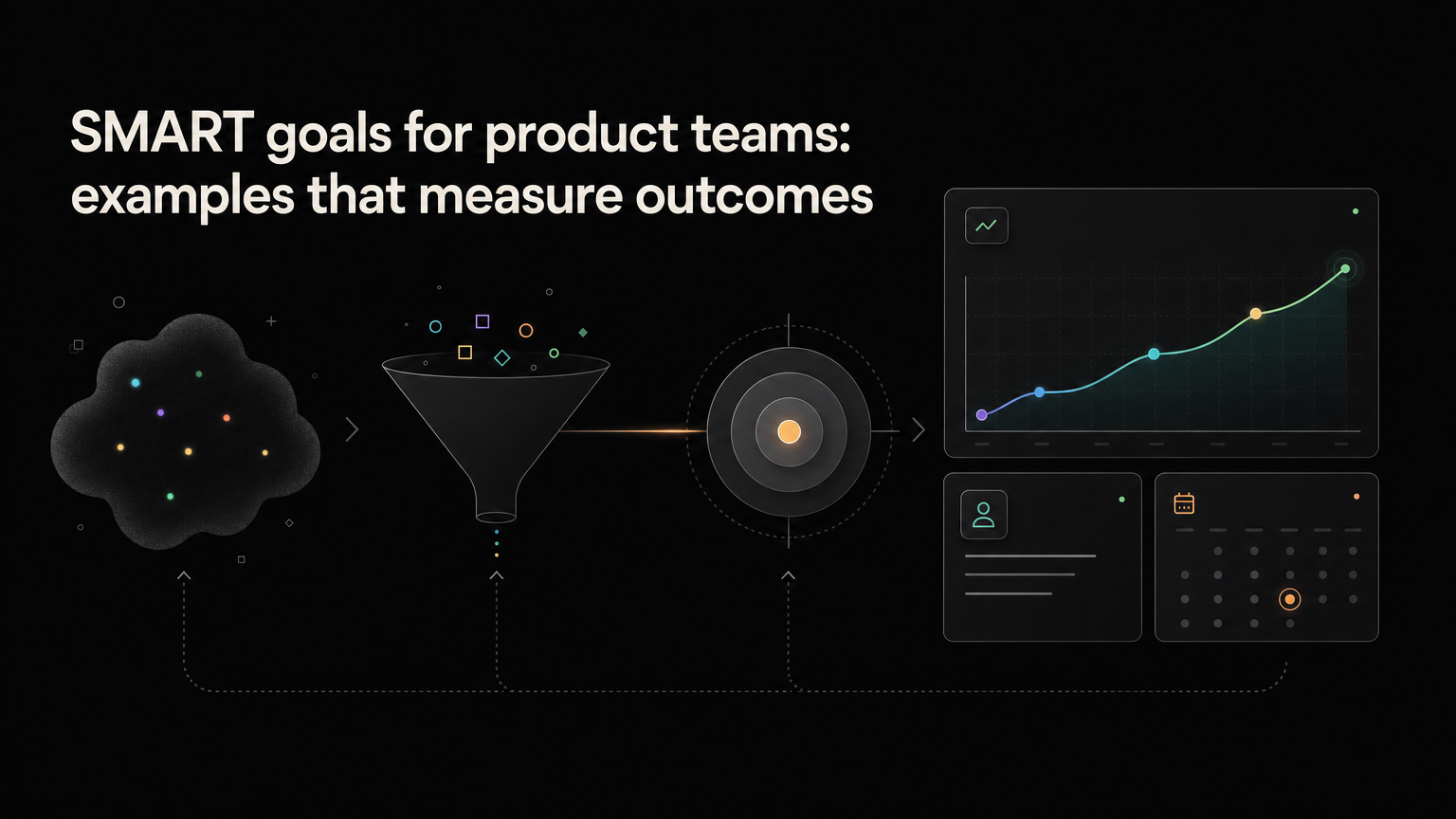
SMART stands for specific, measurable, achievable, relevant, and time-bound.
The five parts of a SMART product goal
Specific
Name the customer, behavior, or workflow.
Vague:
Make onboarding better.
Specific:
Help new workspace owners invite their first teammate during setup.
Measurable
Choose a result you can observe. Product goals often use activation, retention, task completion, support volume, or time saved.
Increase the percentage of new workspace owners who invite a teammate within their first session.
The metric should reflect the desired customer behavior, not just the work your team completes.
Achievable
The target should require improvement without depending on fantasy.
Use your baseline, team capacity, and previous experiments. “Increase activation from 42% to 50%” can be evaluated. “Reach 100% activation” ignores the customers who sign up accidentally, choose another product, or have a different workflow.
Relevant
Connect the goal to the current product strategy.
If the company is focused on team adoption, inviting a teammate may matter. If it is focused on individual creators, that same metric could push the product in the wrong direction.
Time-bound
Set a review date.
The deadline creates a learning cycle. It tells the team when to evaluate the result, not when to declare victory regardless of the data.
SMART goal examples
Activation
Increase the percentage of new workspace owners who complete setup and invite one teammate within seven days from 36% to 45% by September 30.
Retention
Increase eight-week retention for new agency accounts from 51% to 58% by the end of Q4.
Customer feedback
Acknowledge 90% of new feedback submissions within two business days during August.
Support efficiency
Reduce support tickets about report exports by 25% within six weeks of releasing the redesigned export flow.
Product communication
Notify at least 95% of identified requesters within one day when a requested feature ships this quarter.
Each example defines a result. “Ship the new onboarding checklist” is a milestone that may support the activation goal, but it is not the customer outcome.
Separate goals, measures, and initiatives
Teams often put all three in one sentence.
Use this structure:
Goal: More new teams reach their first shared result.
Measure: Team activation rises from 36% to 45% by September 30.
Initiatives: Simplify workspace setup, improve invitations, and test an onboarding checklist.
The initiatives can change while the goal remains stable. If an experiment fails, the team can try another approach without pretending the goal changed.
Add a guardrail
A local improvement can create a new problem elsewhere.
If you push invitations too aggressively, more people may send unwanted invites or abandon setup. Add a guardrail:
Increase team activation to 45% while keeping setup abandonment below 12%.
Guardrails are especially useful for goals involving notifications, conversion, or speed.
Use customer feedback to explain the metric
A metric tells you what changed. Customer feedback helps you understand why.
If activation falls, review support conversations, onboarding comments, and requests from new users. If a new flow improves the number but creates repeated complaints, the quantitative result is incomplete.
Link major feedback themes to the goal they may affect. This keeps the roadmap grounded in both behavior and customer context.
Review goals without moving the target
At the deadline, record:
- The result
- What the team shipped or tested
- What the team learned
- Unexpected effects
- The next decision
Do not rewrite the original target after the fact. A missed goal with a clear lesson is more valuable than a perfect-looking report built from changed definitions.
Feedboard helps product teams connect customer feedback to roadmap work and report back when improvements ship. Start using Feedboard.
Choose a trustworthy baseline
Define the population, event, and time window before setting the target.
“Activation is 36%” is incomplete. A usable baseline is:
Among new self-serve workspaces created in June, 36% invited a teammate and completed one shared task within seven days.
Exclude test, employee, and duplicate accounts consistently. Keep the definition stable through the goal period.
Use leading and lagging measures
Lagging measures show the final outcome: retention, revenue, renewal, or customer satisfaction. Leading measures show behavior expected to contribute to it.
For a retention goal:
- Lagging: eight-week workspace retention
- Leading: first-week team activation
- Diagnostic: time to first invite and support contacts
- Guardrail: unwanted invitation rate
Do not replace the lagging outcome with an easy activity metric.
Worked example
The team wants to “improve feedback engagement.”
It rewrites the goal:
Increase the percentage of paid workspaces that submit or support one feedback item during a quarter from 18% to 25% by December 31, while keeping median first-response time below two business days.
Initiatives may include in-product board access, support-assisted submission, and requester notifications.
The response-time guardrail prevents promotion from creating an unanswered backlog.
Make ownership explicit
Assign:
- Goal owner
- Metric owner
- Initiative owners
- Review cadence
- Decision maker
The goal owner is responsible for learning and decisions, not personally completing every task.
Run a weekly review
Use:
Current result:
Expected trajectory:
Leading indicators:
Guardrails:
Work completed:
What we learned:
Risks:
Decision before next review:
Avoid a meeting that only reports status. Change or stop initiatives when evidence shows they are not influencing the goal.
Handle missed goals
Separate execution, assumption, and measurement failures.
- Execution: the initiative was not delivered or adopted.
- Assumption: the initiative worked but did not affect the outcome.
- Measurement: the metric or instrumentation was unreliable.
- External: a major event changed the baseline or population.
Record which explanation the evidence supports. Do not lower the target retroactively.
SMART goal worksheet
Audience:
Customer outcome:
Baseline and period:
Target and deadline:
Why it supports strategy:
Leading measure:
Lagging measure:
Guardrail:
Initiatives:
Owner:
Review cadence:
More examples
Feedback response
Reduce median first response to new paid-customer feedback from 3.8 business days to 1.5 by October 31, without increasing unresolved posts older than thirty days.
Changelog adoption
Increase the percentage of affected accounts using a released scheduling feature within thirty days from 22% to 35% during Q4.
Discovery
Complete twelve recent-event interviews with agency administrators and make a documented go, revise, or stop decision on client reporting by September 15.
The discovery example measures completion of a decision process because the customer outcome cannot yet be known.
Frequently asked questions
Should every goal be SMART?
Vision and strategic direction can remain broader. Work being managed and reviewed benefits from measurable definitions.
How ambitious should the target be?
Use baseline data, available capacity, and uncertainty. A target should create a meaningful choice without depending on assumptions nobody has tested.
Can qualitative evidence be part of a goal?
Yes. Define the evidence and decision it supports. Do not pretend interview counts alone equal customer value.
How many goals should one team own?
Few enough that tradeoffs are real. One to three major outcomes per period is a useful constraint for small teams.