%20--%3e%3cdefs%3e%3cstyle%3e%20.st0%20{%20fill:%20%23fff;%20}%20%3c/style%3e%3c/defs%3e%3cpath%20class='st0'%20d='M37.06,124.64c1.42-.39,3.06.14,4.14.77,29.56,17.44,67.54,6.48,83.47-23.79,9.31-17.68,10.16-36.97,1.54-55.34-1.29-2.76.63-5.66,3.07-6.48,2.76-.91,5.34.33,6.56,2.99,7.71,16.78,8.53,35.39,2.51,52.8-14.32,41.46-61.44,61.08-100.66,39.6l-28.54,8.18c-1.53.44-3.51-.85-4.32-1.78-1.07-1.23-1.51-2.99-1.06-4.68l7.42-27.48C1.75,93.06-1.86,75.29,2.43,56.85,9.85,24.85,36.89,1.27,70.09.31c14.91-.43,29.09,3.99,41.7,12.54l-.36-5.47c-.17-2.66,1.42-4.88,3.81-5.4,2.05-.44,5.56.58,5.97,3.25,1.09,7.06,1.8,14.07,2.44,21.4.2,2.3-2.47,4.71-4.65,4.73l-18.11.08c-2.8,0-5.09-1.59-5.5-4.35-.35-2.36,1.31-5.56,4.1-5.59l6.44-.08C76.96,1.23,36.92,10.4,19.4,41.02c-11.87,20.72-11.49,44.19,1.31,64.59.85,1.31,1.36,2.49.93,4.03l-5.58,20.83,20.99-5.85.02.02Z'/%3e%3cpath%20class='st0'%20d='M91.43,92.7c4.29,0,7.09-3.34,6.98-7.09-.11-4.05-3.59-7.03-7.8-6.51h-20.19l3.67-10.15,16.89-.03c3.39,0,5.97-2.47,6.48-5.72.33-2.08-.3-4.22-1.58-5.63-1.45-1.59-3.44-2.1-5.64-2.1l-14.72.05,3.1-10.18c4.29-.19,8.41-.33,12.75-.13,7.66.35,14.32,5.25,16.03,12.72,1.36,5.97-.65,11.99-5.85,15.54,3.21,2.02,5.5,4.76,6.49,8.59,2.55,9.85-4.33,20.06-14.94,20.56l-32.37.2,3.73-10.07,9.74-.08h17.21v.02Z'/%3e%3cpath%20class='st0'%20d='M68.08,68.96l-3.36,10.12-18.41.03-.06,23.7h-10.38v-56.96c0-.5,1.61-.71,2.14-.71h6.97l27.17-.02-3.18,10.34-22.63.14-.03,13.33,21.78.05v-.02Z'/%3e%3c/svg%3e)
Ideas are cheap. Attention is not.
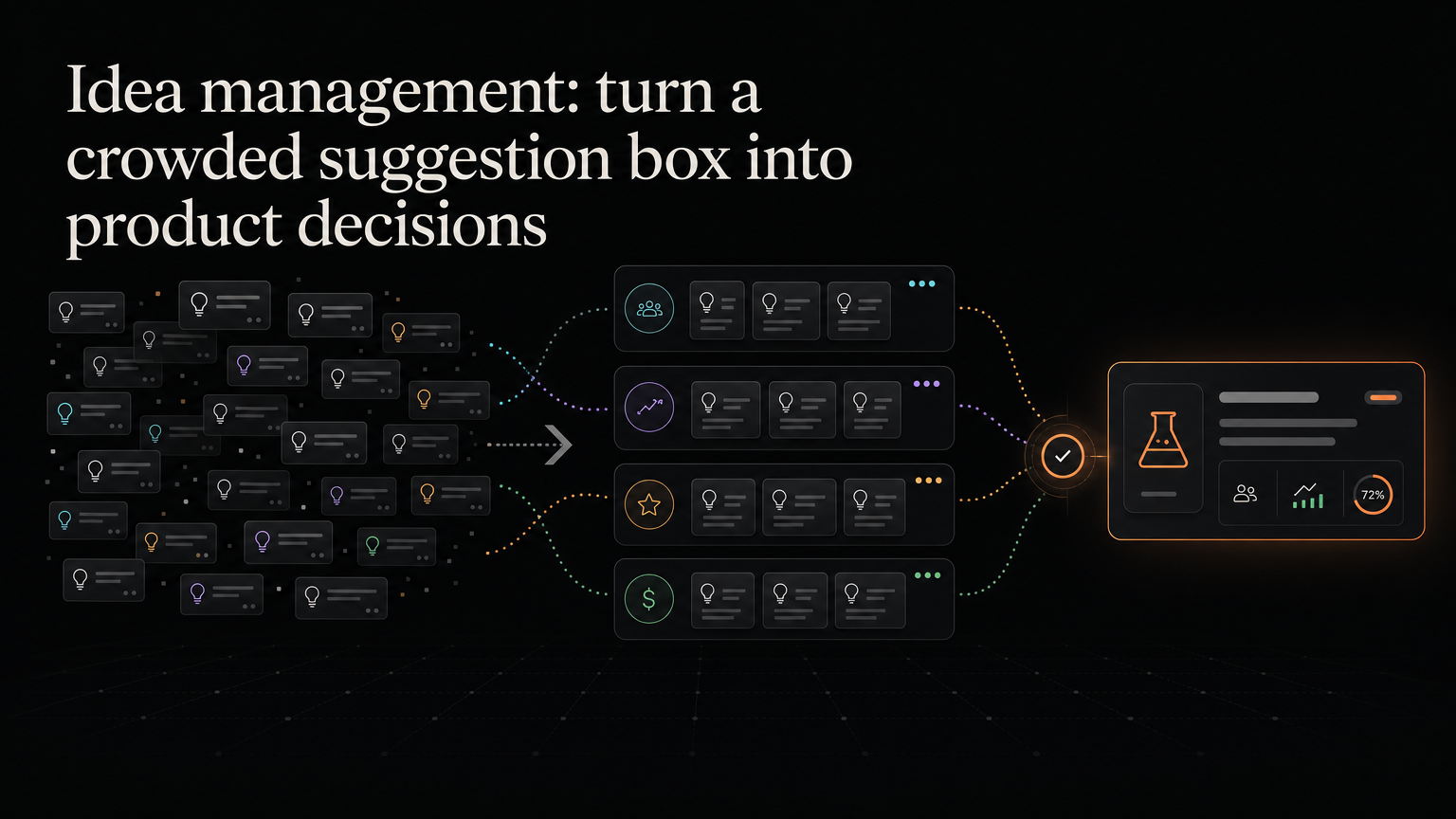
A product team can collect hundreds of suggestions from customers and still have no clear sense of what to do next. The useful work is connecting repeated suggestions to real problems, testing the strongest opportunities, and recording why the team chose one direction over another.
That is idea management.
What is idea management?
Idea management is a repeatable way to collect, organize, evaluate, and act on suggestions.
For a software product, ideas may come from:
- Customer feedback
- Support and success conversations
- Sales objections
- Usage data
- Team observations
- Competitor research
- Technical opportunities
The process should accept all of these without pretending they are equally reliable. A customer request, a founder instinct, and a drop in activation are different kinds of evidence.
Separate ideas from problems
Customers usually describe a solution:
Add a weekly PDF report.
The underlying problem may be:
I have to update a client who never logs in.
If you record only the proposed feature, you narrow the solution too early. A shareable live report, scheduled email, or client dashboard might solve the problem better.
Keep two fields:
- Suggested idea
- Problem or desired outcome
The idea preserves the customer’s words. The problem gives the product team room to think.
A five-stage idea management process
1. Capture
Give customers and teammates a reliable place to submit ideas. Ask for enough context to understand the request, but keep the form short.
A useful submission asks:
- What are you trying to achieve?
- What is difficult today?
- How often does this happen?
- Is there a workaround?
Do not require the submitter to estimate business value or implementation effort. Those questions belong with the team reviewing the idea.
2. Organize
Merge duplicates and group related requests under an opportunity theme.
For example:
- “PDF invoice”
- “Print invoice”
- “Email invoice as attachment”
These may belong to a broader theme such as “share invoices outside the app.”
Themes help the team see patterns without losing the individual details. They are also more stable than feature names, which often change during discovery.
3. Qualify
Decide whether the opportunity deserves more research.
Look for evidence:
- Several target customers report the same problem
- The problem is frequent or expensive
- A workaround creates measurable friction
- The opportunity supports a current company goal
- Solving it could improve activation, retention, expansion, or cost
An idea can be sensible and still be wrong for the current strategy. Mark it accordingly rather than leaving it in an endless review queue.
4. Test
Before committing to a large build, test the riskiest assumption.
You might:
- Interview the people who submitted the idea
- Show a prototype
- Offer a manual version
- Add a waitlist
- Run a small beta
- Measure whether the current workflow is actually causing drop-off
The test should answer a decision question. “Do customers like this mockup?” is weak. “Will finance managers schedule this report at least once a month?” is specific.
5. Decide and communicate
Choose one of a small number of outcomes:
- Move to the roadmap
- Keep exploring
- Revisit later
- Decline
Record the reason. When the idea came from customers, send an update to the people who contributed.
The decision log matters. Six months later, a new teammate should be able to see whether an idea was rejected because of poor evidence, high cost, bad timing, or a change in strategy.
How to evaluate product ideas
Use a short opportunity brief instead of a complicated scoring model.
Opportunity:
Who has this problem?
What happens today?
How often does it occur?
Evidence:
Expected outcome:
Smallest test:
Main risk:
Decision:
For larger teams, add reach, impact, confidence, and effort. For small teams, false precision can waste more time than it saves. A score of 7.4 is not more truthful than a written explanation when the inputs are guesses.
Keep the idea backlog healthy
An unreviewed backlog grows until searching it feels impossible. Use a maintenance routine:
- Review new submissions each week
- Merge duplicates while the context is fresh
- Archive ideas that no longer match the product
- Revisit “later” ideas on a defined date
- Keep public statuses accurate
Do not measure success by the number of ideas collected. Measure whether the system helps the team find strong opportunities and make decisions faster.
Internal ideas need evidence too
Founder and team ideas often skip the process because they arrive with authority. That creates two standards: customers need proof, while internal suggestions become projects.
Put strategic internal ideas through the same opportunity brief. The evidence may differ, but the questions should remain visible. This improves the decision and makes the reasoning easier to share.
Build a learning system, not an idea warehouse
The best idea management system gets smaller as the team learns. Duplicates combine, weak ideas close, and promising themes move into discovery.
Feedboard gives customers and teammates one place to submit ideas, follow decisions, and see what ships. Start organizing product ideas with Feedboard.
Define governance
Assign:
- Intake owner
- Theme owners
- Research owner
- Roadmap decision maker
- Customer communication owner
One person can hold several roles. Naming them prevents ideas from becoming everyone’s responsibility and nobody’s work.
Use an idea funnel
Track:
- Submitted
- Cleaned and merged
- Linked to a problem theme
- Qualified for research
- Tested
- Planned or declined
- Released and measured
The funnel should narrow. If every submission reaches research, the qualification rules are too weak.
Worked example
Customers request:
- PDF invoices
- Printable invoices
- Email attachments
- Branded invoice links
The team groups them under:
Customers need to send a professional invoice to people who do not use the product.
Interviews show most recipients prefer a link with a downloadable PDF. The team tests one shareable view rather than building four independent requests.
Original requesters remain linked and receive the final update.
Manage internal ideas
Require internal proposals to include:
Customer and problem:
Strategic reason:
Evidence:
Expected outcome:
Main assumption:
Smallest test:
What this displaces:
Owner and review date:
Authority can justify a strategic bet, but it should not remove the learning plan.
Funnel metrics
Measure:
- Time to acknowledgement
- Duplicate rate
- Ideas linked to customer evidence
- Themes qualified for research
- Tests producing a decision
- Time under review
- Declined ideas with reasons
- Requesters notified
- Released outcomes that change behavior
Do not reward the number of submissions or features shipped.
Create a decision log
Date:
Opportunity:
Evidence reviewed:
Options considered:
Decision:
Reason:
Assumptions remaining:
Revisit trigger:
Customer message:
The log prevents the same debate from restarting after team changes.
Handle stale ideas
Review ideas that have received no new evidence, relate to removed product areas, or remain under review beyond the agreed period.
Merge, decline, archive, or assign research. Do not keep them visible as implied possibilities forever.
Frequently asked questions
Should customers see declined ideas?
Keep a customer-safe decision and reason when transparency helps. Remove sensitive or inappropriate content according to moderation rules.
How many ideas should be tested?
Only those connected to important problems and current strategy. Capacity should constrain the research queue.
Are hackathons part of idea management?
They can explore technical possibilities. Connect promising results to a customer problem and validation plan before roadmap commitment.
What is the difference between an idea and an opportunity?
An idea proposes a solution. An opportunity describes a valuable customer or business problem worth solving.