%20--%3e%3cdefs%3e%3cstyle%3e%20.st0%20{%20fill:%20%23fff;%20}%20%3c/style%3e%3c/defs%3e%3cpath%20class='st0'%20d='M37.06,124.64c1.42-.39,3.06.14,4.14.77,29.56,17.44,67.54,6.48,83.47-23.79,9.31-17.68,10.16-36.97,1.54-55.34-1.29-2.76.63-5.66,3.07-6.48,2.76-.91,5.34.33,6.56,2.99,7.71,16.78,8.53,35.39,2.51,52.8-14.32,41.46-61.44,61.08-100.66,39.6l-28.54,8.18c-1.53.44-3.51-.85-4.32-1.78-1.07-1.23-1.51-2.99-1.06-4.68l7.42-27.48C1.75,93.06-1.86,75.29,2.43,56.85,9.85,24.85,36.89,1.27,70.09.31c14.91-.43,29.09,3.99,41.7,12.54l-.36-5.47c-.17-2.66,1.42-4.88,3.81-5.4,2.05-.44,5.56.58,5.97,3.25,1.09,7.06,1.8,14.07,2.44,21.4.2,2.3-2.47,4.71-4.65,4.73l-18.11.08c-2.8,0-5.09-1.59-5.5-4.35-.35-2.36,1.31-5.56,4.1-5.59l6.44-.08C76.96,1.23,36.92,10.4,19.4,41.02c-11.87,20.72-11.49,44.19,1.31,64.59.85,1.31,1.36,2.49.93,4.03l-5.58,20.83,20.99-5.85.02.02Z'/%3e%3cpath%20class='st0'%20d='M91.43,92.7c4.29,0,7.09-3.34,6.98-7.09-.11-4.05-3.59-7.03-7.8-6.51h-20.19l3.67-10.15,16.89-.03c3.39,0,5.97-2.47,6.48-5.72.33-2.08-.3-4.22-1.58-5.63-1.45-1.59-3.44-2.1-5.64-2.1l-14.72.05,3.1-10.18c4.29-.19,8.41-.33,12.75-.13,7.66.35,14.32,5.25,16.03,12.72,1.36,5.97-.65,11.99-5.85,15.54,3.21,2.02,5.5,4.76,6.49,8.59,2.55,9.85-4.33,20.06-14.94,20.56l-32.37.2,3.73-10.07,9.74-.08h17.21v.02Z'/%3e%3cpath%20class='st0'%20d='M68.08,68.96l-3.36,10.12-18.41.03-.06,23.7h-10.38v-56.96c0-.5,1.61-.71,2.14-.71h6.97l27.17-.02-3.18,10.34-22.63.14-.03,13.33,21.78.05v-.02Z'/%3e%3c/svg%3e)
Customer feedback creates a particular kind of pressure: every request belongs to a real person with a real problem.
That does not make every request equally important.
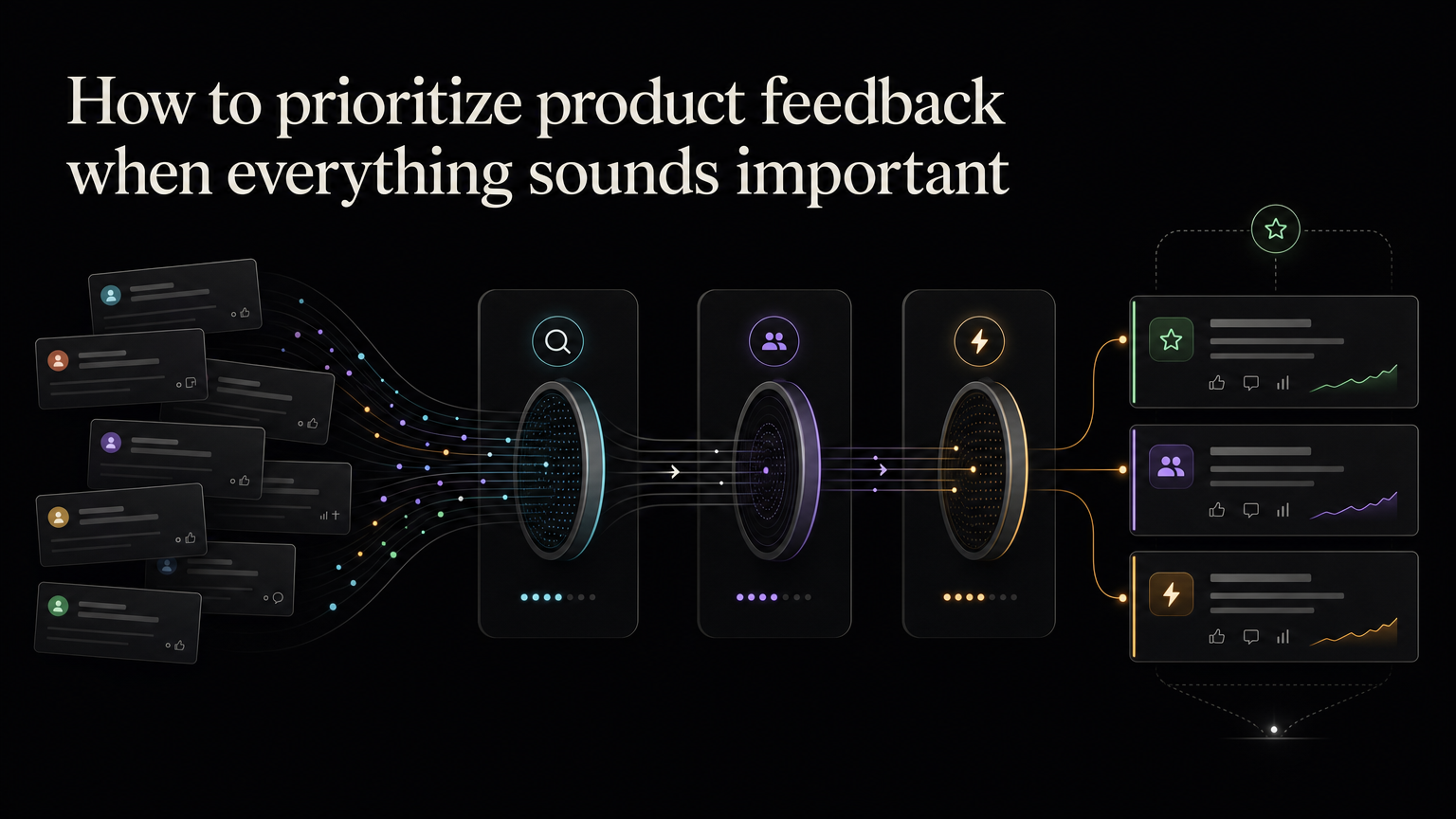
Prioritization is the work of choosing which problems deserve attention now, which need more evidence, and which do not fit the product. A good process respects the customer without handing the roadmap to the loudest voice.
Start with problems, not feature names
“Add dashboards” is hard to prioritize. It could mean an executive wants a weekly overview, an analyst needs custom charts, or an account manager wants client-facing reports.
Rewrite the request as a problem:
Team leads cannot see project risk without opening each project separately.
Now you can investigate who has the problem, how often it occurs, and what it costs.
Group similar requests around that problem. Preserve the individual customer notes so the theme does not become vague.
Use six inputs
1. Target customer fit
Is this problem common among the customers your product is designed to serve?
A request from a famous company can be tempting, but building a special workflow for an outlier may pull the product away from its market.
2. Severity and frequency
A daily blocker is different from a preference used twice a year.
Ask what happens today, how often, and whether the customer has a workable alternative. The strongest problems are both frequent and costly.
3. Reach
Count affected customers or users, not just votes. Look for duplicate requests across support, sales, churn notes, and interviews.
Use a defined time window. Lifetime totals favor old requests and can hide a recent change in demand.
4. Strategic fit
A product strategy is a filter. If the team is trying to improve self-serve onboarding, a request that reduces setup friction may matter more than an unrelated power-user feature.
“Customers asked for it” explains the source. It does not explain why the team should act now.
5. Expected impact
Name the outcome the work should change:
- More users complete activation
- Fewer accounts churn because of a missing workflow
- Support volume falls
- Customers upgrade
- A task takes less time or fewer steps
If the expected outcome cannot be stated, the proposed work is not ready for prioritization.
6. Effort and uncertainty
Effort includes engineering, design, migration, documentation, support, and ongoing maintenance.
Uncertainty deserves its own attention. A two-week project with unknown technical risk may be a worse bet than a four-week project the team understands.
A lightweight priority brief
Use one page per opportunity:
Problem:
Target customer:
Evidence:
Frequency and severity:
Strategic link:
Expected outcome:
Smallest useful version:
Effort and risks:
What this displaces:
Decision:
This is enough structure for a small team. A numerical model can help compare a large set, but it should summarize judgment rather than hide it.
Where scoring models help
Frameworks such as RICE use reach, impact, confidence, and effort. They are useful when:
- Inputs are measured consistently
- The team compares similar opportunities
- Scores lead to a discussion
- Assumptions remain visible
They are less useful when people invent precise numbers to win an argument.
A request with “impact 8.7” is not evidence. Write down what you expect to change and why you believe it.
Add confidence to every claim
Separate what you know from what you assume.
Evidence can include:
- Repeated customer interviews
- Observed product behavior
- Support volume
- Lost or delayed deals
- Churn reasons
- Prototype tests
- A manual pilot
The weakest form is an untested internal opinion. That does not make the idea wrong, but it tells you what to investigate next.
Make opportunity cost visible
Every roadmap discussion should include:
If we do this, what will we delay?
Without that question, prioritization becomes a list of individually attractive ideas. The team says yes repeatedly and discovers the tradeoff during delivery.
Name the displaced work. This forces a real choice.
Decide, then communicate
Use four outcomes:
- Commit: move it to the roadmap
- Explore: gather specific missing evidence
- Park: revisit after a defined trigger or date
- Decline: close it with a recorded reason
Tell customers when the state changes. A thoughtful no protects trust better than a permanent “maybe.”
Review priorities on a cadence
Priorities change when evidence or strategy changes, not every time a new request arrives.
Run a weekly intake review to clean and group feedback. Hold a deeper monthly or quarterly review for roadmap decisions. This keeps urgent-looking messages from constantly interrupting committed work.
Feedboard gives your team one place to group feedback, record demand, and move selected work onto a public roadmap. Prioritize feedback in Feedboard.
Use a confidence scale
Label evidence:
- 20%: internal assumption or vague request
- 40%: one recent customer example
- 60%: repeated examples with clear context
- 80%: observed behavior and measurable consequence
- 100%: validated outcome from a representative pilot
The percentages are communication shorthand, not statistical certainty. Record what would increase confidence.
Worked scoring example
Compare two opportunities:
| Input | Scheduled reports | Custom themes |
|---|---|---|
| Target accounts affected | 18 | 30 |
| Problem severity | High weekly cost | Low preference |
| Strategic fit | High | Medium |
| Confidence | 80% | 40% |
| Estimated effort | Medium | Low |
| Expected outcome | Retention and time saved | Brand consistency |
Custom themes have more requests and lower effort. Scheduled reports may still win because the problem is severe, evidence is stronger, and the outcome supports strategy.
The table makes the tradeoff explainable without pretending one score contains the decision.
Facilitate the decision meeting
Send briefs before the meeting. For each opportunity:
- State the problem and segment.
- Review evidence and contradictions.
- Confirm strategic link.
- Discuss smallest useful version.
- Identify cost and risk.
- Name displaced work.
- Choose commit, explore, park, or decline.
Do not spend the meeting reading raw submissions for the first time.
Account for portfolio balance
A roadmap may need reliability, growth, retention, compliance, and platform work. Ranking every item in one list can push essential maintenance below visible features.
Allocate capacity or review within strategic portfolios, then compare the strongest opportunities across them.
Prevent scoring manipulation
Use shared definitions for reach, impact, confidence, and effort. Require a source for numbers.
Review suspicious precision. “Impact 8.6” should become an expected measurable outcome and evidence.
Keep estimates independent where useful: product assesses impact and engineering assesses effort before a negotiation changes them.
Revisit decisions
Parked work needs a trigger:
- New target segment
- Ten additional affected accounts
- Required platform capability complete
- Renewal risk above a threshold
- Review date
Without a trigger, “later” becomes an unowned backlog.
Communicate priorities
Tell customers:
- What is being explored or planned
- What problem the team intends to solve
- What remains uncertain
- Why an idea is declined when useful
- When the next update will happen
Do not expose private revenue context or promise an exact implementation before discovery.
Prioritization quality metrics
Track:
- Opportunities with linked evidence
- Decisions made on schedule
- Planned items that reach a customer outcome
- Roadmap churn
- Parked items revisited
- Requesters notified
- Outcomes achieved after release
Shipping the highest-scored card is not proof that the process worked.
Frequently asked questions
Should revenue decide priority?
Revenue is relevant context, especially for retention and deals. Balance it with strategy, reach, customer harm, cost, and long-term product direction.
How are small customers represented?
Segment feedback, examine frequency and severity, and avoid letting account value erase a problem common across many smaller customers.
What if founders override the process?
Record the strategic decision and assumptions. Leadership can make a bet; it should remain testable and visible.
How often should priorities change?
When evidence, strategy, capacity, or risk changes materially. Constant reaction to new submissions prevents meaningful delivery.