%20--%3e%3cdefs%3e%3cstyle%3e%20.st0%20{%20fill:%20%23fff;%20}%20%3c/style%3e%3c/defs%3e%3cpath%20class='st0'%20d='M37.06,124.64c1.42-.39,3.06.14,4.14.77,29.56,17.44,67.54,6.48,83.47-23.79,9.31-17.68,10.16-36.97,1.54-55.34-1.29-2.76.63-5.66,3.07-6.48,2.76-.91,5.34.33,6.56,2.99,7.71,16.78,8.53,35.39,2.51,52.8-14.32,41.46-61.44,61.08-100.66,39.6l-28.54,8.18c-1.53.44-3.51-.85-4.32-1.78-1.07-1.23-1.51-2.99-1.06-4.68l7.42-27.48C1.75,93.06-1.86,75.29,2.43,56.85,9.85,24.85,36.89,1.27,70.09.31c14.91-.43,29.09,3.99,41.7,12.54l-.36-5.47c-.17-2.66,1.42-4.88,3.81-5.4,2.05-.44,5.56.58,5.97,3.25,1.09,7.06,1.8,14.07,2.44,21.4.2,2.3-2.47,4.71-4.65,4.73l-18.11.08c-2.8,0-5.09-1.59-5.5-4.35-.35-2.36,1.31-5.56,4.1-5.59l6.44-.08C76.96,1.23,36.92,10.4,19.4,41.02c-11.87,20.72-11.49,44.19,1.31,64.59.85,1.31,1.36,2.49.93,4.03l-5.58,20.83,20.99-5.85.02.02Z'/%3e%3cpath%20class='st0'%20d='M91.43,92.7c4.29,0,7.09-3.34,6.98-7.09-.11-4.05-3.59-7.03-7.8-6.51h-20.19l3.67-10.15,16.89-.03c3.39,0,5.97-2.47,6.48-5.72.33-2.08-.3-4.22-1.58-5.63-1.45-1.59-3.44-2.1-5.64-2.1l-14.72.05,3.1-10.18c4.29-.19,8.41-.33,12.75-.13,7.66.35,14.32,5.25,16.03,12.72,1.36,5.97-.65,11.99-5.85,15.54,3.21,2.02,5.5,4.76,6.49,8.59,2.55,9.85-4.33,20.06-14.94,20.56l-32.37.2,3.73-10.07,9.74-.08h17.21v.02Z'/%3e%3cpath%20class='st0'%20d='M68.08,68.96l-3.36,10.12-18.41.03-.06,23.7h-10.38v-56.96c0-.5,1.61-.71,2.14-.71h6.97l27.17-.02-3.18,10.34-22.63.14-.03,13.33,21.78.05v-.02Z'/%3e%3c/svg%3e)
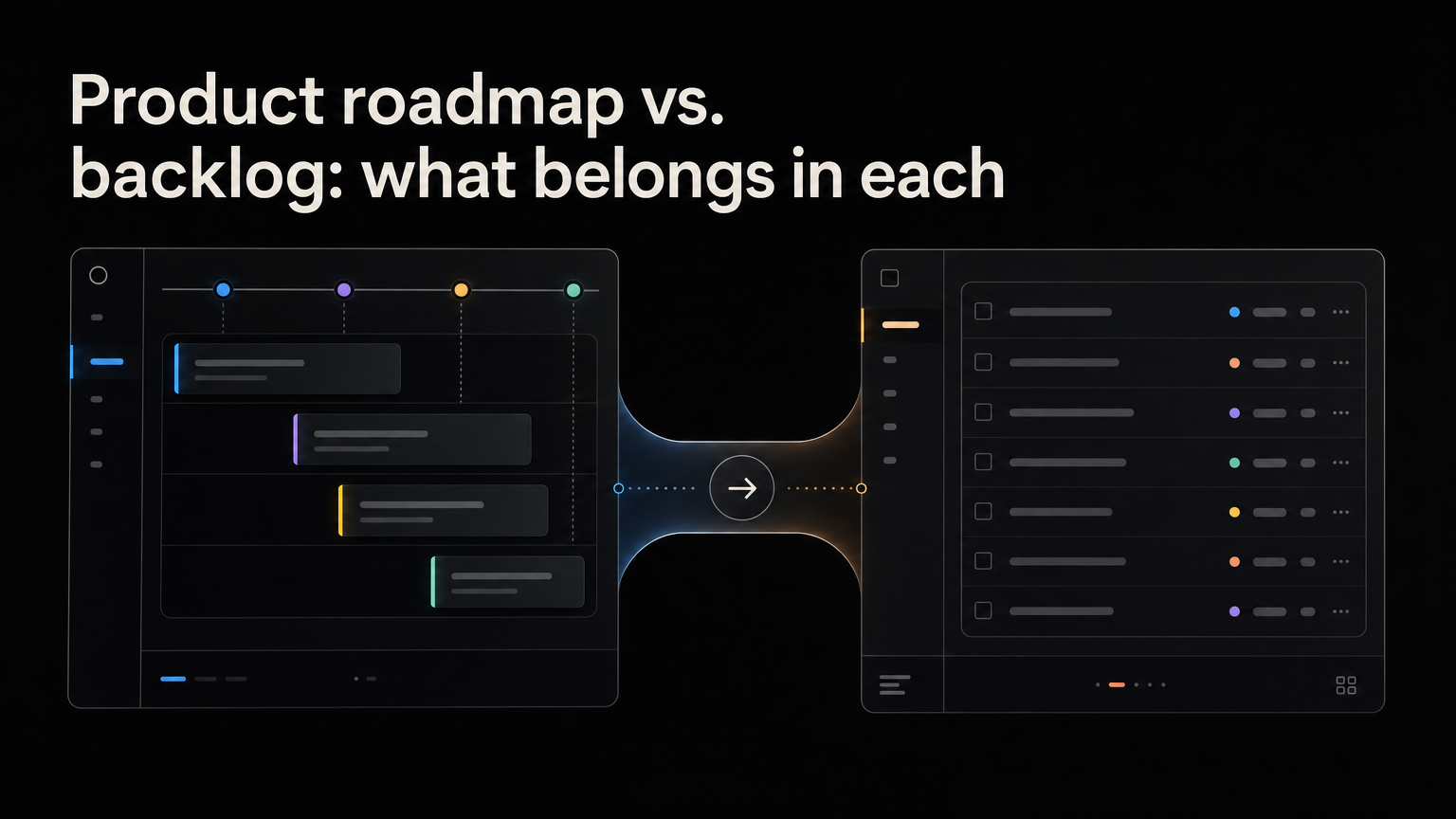
A roadmap explains direction. A backlog organizes possible and committed work.
When teams combine them, the roadmap becomes a wall of tickets and the backlog starts carrying strategy it cannot explain.
The roadmap
A product roadmap communicates:
- Customer problems or outcomes
- Strategic themes
- Current priorities
- Broad status or time horizon
- The reason the work matters
Write items so a customer or executive can understand the intended change. “Reduce the time to build a weekly client report” belongs on a roadmap.
The backlog
A backlog contains:
- Discovery tasks
- Features and stories
- Bugs
- Technical work
- Acceptance criteria
- Delivery details
“Add date-range validation to scheduled reports” belongs in the backlog.
Keep the link
One roadmap outcome may require several backlog items. Link them rather than copying every task into the public view.
Connect the roadmap item to its customer feedback too:
Feedback → product outcome → delivery work → release note
That chain preserves the reason behind the tasks.
Do not publish the whole backlog
Unreviewed requests are possibilities, not promises. Publishing them creates false expectations and makes important direction hard to see.
A public roadmap should be curated. A feedback board can separately show ideas under review.
Review at different speeds
The delivery team may refine the backlog every week. Roadmap direction should change when strategy or evidence changes, not whenever a ticket moves.
Add a third layer: feedback intake
Raw customer feedback should not go directly into the delivery backlog.
Use three layers:
- Feedback inbox: problems, requests, and evidence awaiting review.
- Roadmap: selected outcomes the team intends to pursue.
- Backlog: research and delivery work supporting those outcomes.
Not every request reaches the roadmap. Not every roadmap item begins as a request. Reliability, compliance, strategy, and technical capability also drive work.
Example from request to release
A customer says:
I export the same report every Monday and email it to six people.
The feedback record preserves the account, workflow, and workaround. After similar reports and interviews, the roadmap outcome becomes:
Help teams distribute recurring reports without manual exports.
The backlog can then contain discovery interviews, a scheduling prototype, permission work, delivery infrastructure, failure handling, and documentation.
The release note finally says:
Schedule reports for automatic email delivery.
Each layer uses the detail its audience needs.
Map statuses without forcing them
| Feedback | Roadmap | Backlog |
|---|---|---|
| Under review | Exploring | Discovery |
| Planned | Planned | Prioritized |
| In progress | In progress | Active |
| Shipped | Shipped | Done |
| Not planned | No item | Closed or absent |
A research task can be active while the request remains under review. Research does not mean the solution is committed.
Assign ownership
Product owns roadmap outcomes. Delivery teams own backlog detail. A feedback owner keeps customer evidence clean, linked, and updated.
One person may hold all three roles in a small company. The artifacts should still stay separate.
Warning signs
The roadmap is acting like a backlog when it has hundreds of items, technical ticket titles, sprint-level changes, and no explanation of customer outcomes.
The backlog is acting like a roadmap when stakeholders infer strategy from ticket order, important work has no linked objective, and completed tasks do not add up to a recognizable customer result.
Frequently asked questions
Should bugs appear on the roadmap?
Only when a reliability outcome is important enough to communicate. Individual defects belong in the issue tracker.
Does every roadmap item need a date?
No. Use broad horizons until scope and confidence support a date.
Should customers see the backlog?
They usually need request statuses, a curated roadmap, and release notes. Delivery tickets add noise and may expose sensitive details.
Feedboard holds the feedback and customer-facing roadmap while your project tracker handles delivery detail. Build a clearer roadmap with Feedboard.
Connect strategy to the three layers
Add an outcome above the roadmap item:
Business outcome: Improve retention among agency accounts.
Customer problem: Account managers repeat client reporting manually.
Roadmap outcome: Distribute recurring reports without manual exports.
Backlog work: Research, permissions, scheduling, delivery, monitoring.
This prevents a roadmap of attractive ideas with no company-level reason.
Run distinct cadences
Continuous intake
Capture and acknowledge new feedback. Urgent bugs use a separate path.
Weekly backlog refinement
Clarify active work, dependencies, acceptance criteria, and sequencing.
Monthly roadmap review
Review evidence, status, risks, and communication for current outcomes.
Quarterly strategy review
Confirm that roadmap themes still support the chosen customer and business direction.
Changing cadences does not mean information is disconnected. Each review updates linked records at the appropriate level.
Roadmap-item template
Customer problem:
Affected segment:
Evidence:
Intended outcome:
Success measure:
Current status:
What is explicitly out of scope:
Linked feedback:
Linked delivery initiative:
Latest customer-safe update:
Avoid filling the public description with internal dependencies or estimates.
Backlog-item quality
Every prioritized backlog item should link to an outcome, operational requirement, or defect. If the team cannot explain why a task exists, it may be stale.
Technical work can link to reliability, security, cost, developer velocity, or a customer outcome. It does not need a fake feature-request origin.
Worked example: changing evidence
A roadmap item promises scheduled PDF reports. During research, customers reveal that most recipients need a live view because data changes during the week.
The team updates the roadmap outcome to “share a focused report with external recipients.” The original PDF backlog is not blindly completed. New discovery and permission tasks replace it.
Customers receive an update explaining the refined outcome without seeing every removed ticket.
Handle cancelled work
When a roadmap item is cancelled:
- Record the decision and evidence.
- Close or archive linked delivery work.
- Update the public status.
- Notify requesters.
- Preserve the history for future review.
Deleting the item hides the decision and invites the same debate later.
Metrics
Measure:
- Roadmap outcomes with success measures
- Active backlog linked to an objective
- Stale roadmap updates
- Time from feedback theme to decision
- Requesters notified after status changes
- Outcomes achieved, not only items shipped
Delivery velocity does not prove the roadmap chose the right problem.
Additional FAQs
Where do experiments belong?
The learning goal can appear on the roadmap when strategically important. Experiment tasks and variants belong in the backlog.
Where does technical debt belong?
In the backlog, linked to reliability, cost, risk, or delivery capability. A broader reliability outcome may appear on the roadmap.
Who sees the internal roadmap?
Leadership and delivery teams may need more evidence and risk detail. Customers need a curated, safe view. Both should reference the same underlying outcome.
What happens to unselected feedback?
It remains in the feedback system with a clear state, not in the prioritized delivery backlog.
Preserve links when tools change. Migration should not separate delivery work from the customer evidence and decisions that explain why it exists.