%20--%3e%3cdefs%3e%3cstyle%3e%20.st0%20{%20fill:%20%23fff;%20}%20%3c/style%3e%3c/defs%3e%3cpath%20class='st0'%20d='M37.06,124.64c1.42-.39,3.06.14,4.14.77,29.56,17.44,67.54,6.48,83.47-23.79,9.31-17.68,10.16-36.97,1.54-55.34-1.29-2.76.63-5.66,3.07-6.48,2.76-.91,5.34.33,6.56,2.99,7.71,16.78,8.53,35.39,2.51,52.8-14.32,41.46-61.44,61.08-100.66,39.6l-28.54,8.18c-1.53.44-3.51-.85-4.32-1.78-1.07-1.23-1.51-2.99-1.06-4.68l7.42-27.48C1.75,93.06-1.86,75.29,2.43,56.85,9.85,24.85,36.89,1.27,70.09.31c14.91-.43,29.09,3.99,41.7,12.54l-.36-5.47c-.17-2.66,1.42-4.88,3.81-5.4,2.05-.44,5.56.58,5.97,3.25,1.09,7.06,1.8,14.07,2.44,21.4.2,2.3-2.47,4.71-4.65,4.73l-18.11.08c-2.8,0-5.09-1.59-5.5-4.35-.35-2.36,1.31-5.56,4.1-5.59l6.44-.08C76.96,1.23,36.92,10.4,19.4,41.02c-11.87,20.72-11.49,44.19,1.31,64.59.85,1.31,1.36,2.49.93,4.03l-5.58,20.83,20.99-5.85.02.02Z'/%3e%3cpath%20class='st0'%20d='M91.43,92.7c4.29,0,7.09-3.34,6.98-7.09-.11-4.05-3.59-7.03-7.8-6.51h-20.19l3.67-10.15,16.89-.03c3.39,0,5.97-2.47,6.48-5.72.33-2.08-.3-4.22-1.58-5.63-1.45-1.59-3.44-2.1-5.64-2.1l-14.72.05,3.1-10.18c4.29-.19,8.41-.33,12.75-.13,7.66.35,14.32,5.25,16.03,12.72,1.36,5.97-.65,11.99-5.85,15.54,3.21,2.02,5.5,4.76,6.49,8.59,2.55,9.85-4.33,20.06-14.94,20.56l-32.37.2,3.73-10.07,9.74-.08h17.21v.02Z'/%3e%3cpath%20class='st0'%20d='M68.08,68.96l-3.36,10.12-18.41.03-.06,23.7h-10.38v-56.96c0-.5,1.61-.71,2.14-.71h6.97l27.17-.02-3.18,10.34-22.63.14-.03,13.33,21.78.05v-.02Z'/%3e%3c/svg%3e)
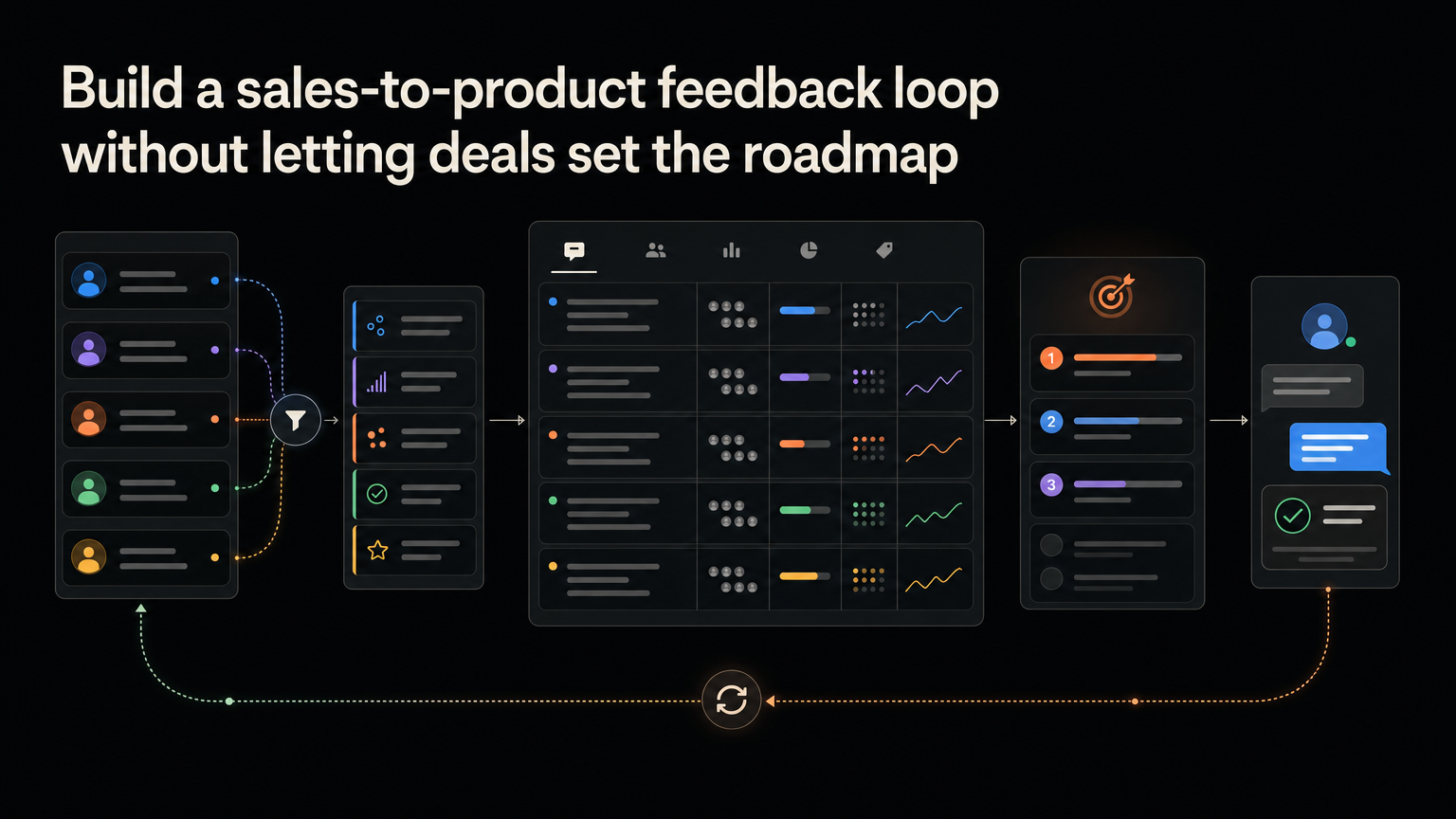
Sales hears why prospects hesitate. Product needs that evidence. The failure happens when every objection becomes a promised feature or when useful call notes never leave the CRM.
Capture the deal context
For each request, record:
- Prospect and segment
- Problem in their words
- Current workaround
- Deal stage and value
- Whether the feature blocks the deal
- Deadline and reason
- Competitor or compliance context
“Enterprise prospect asked for audit logs” is incomplete. The team needs to know whether audit logs are a legal requirement or a preference.
Link, do not duplicate
Attach the prospect to an existing request when possible. This shows demand across customers and keeps the product discussion in one place.
Opportunity value is context, not an automatic priority score.
Give sales safe language
Use response states:
- Collecting evidence
- Under review
- Planned without a committed date
- Committed for a defined window
- Not planned
Only the last two should produce a firm answer. “Planned” is not a contractual promise.
Review patterns together
Hold a regular sales-product review for themes, not a live negotiation over individual deals.
Ask whether requests fit the target market, repeat across opportunities, support strategy, and justify long-term maintenance.
Report back
When a decision changes, notify the salesperson. When a requested capability ships, send a release note they can share with the prospect.
Use a consistent intake brief
Account and segment:
Problem in the prospect's words:
Current workaround:
Business consequence:
Requested capability:
Is the deal blocked?
Opportunity stage and value:
Required date and reason:
Source call:
Keep the problem separate from the requested solution. A prospect asking for custom roles may need to prevent contractors from seeing financial data. Several designs could solve that job.
Test whether it is a blocker
Ask what happens if the capability is unavailable. A real blocker may prevent legal approval, security review, migration, or completion of the core workflow. A preference may improve the evaluation without determining it.
Both are useful. Calling everything a blocker makes the label worthless.
Use commercial value as context
Opportunity value should be visible but should not become the roadmap formula. Review strategic fit, repeated demand, retention value, long-term maintenance, and what the work will displace.
One large deal can justify discovery. It does not automatically justify building.
Run a monthly theme review
Product and sales should review grouped problems rather than negotiate every deal:
- Read representative call context.
- Review linked prospects and customers.
- Check fit with the intended market.
- Identify missing evidence.
- Assign a state and owner.
- Give sales approved response language.
Security and contractual questions can use a separate urgent path.
Define a commitment ladder
| State | Safe message |
|---|---|
| Logged | We recorded the use case. |
| Researching | Product is investigating the problem. |
| Planned | It is on the roadmap without committed timing. |
| Committed | Scope and a delivery window are approved. |
| Released | It is available; here are the details. |
| Declined | It is not planned; here is the current direction. |
Only authorized people should move work into “committed.”
Measure the loop
Track time to response, requests with linked call evidence, repeated themes across opportunities, features that influenced wins, and promised work delivered on time.
Review requests that were built but did not affect the deal. Those are expensive lessons.
Frequently asked questions
Should sales submit on behalf of prospects?
Yes. Do not make prospects repeat the story in another tool. Preserve their words and source.
Should prospects see the roadmap?
Share it when it represents direction accurately. A broad roadmap state is not an exact contractual commitment.
What about lost deals?
Keep the feedback linked to the opportunity and review patterns quarterly. One loss may be unusual; repeated losses in the target segment deserve investigation.
Feedboard keeps prospect requests connected to product decisions and shipped updates. Create a shared feedback workflow.
Separate buyer, user, and approver evidence
The person requesting a capability may not use it.
- Users describe workflow friction.
- Buyers explain commercial value.
- Security or legal approvers state requirements.
- Executives describe expected outcomes.
Record the role behind each statement. “Customer needs audit logs” has different meaning when it comes from a daily administrator or a security reviewer.
Link feedback to CRM stages
Keep product evidence in the feedback system and commercial state in the CRM. Link them rather than copying values manually.
A request should show whether associated opportunities are exploratory, technically validated, negotiating, won, or lost. This helps the team distinguish broad early interest from a recurring late-stage blocker.
Worked example
Five prospects ask for “advanced permissions.”
Call review shows:
- Two need contractors limited to selected projects.
- One needs approval before publishing.
- Two require SAML group mapping for security policy.
One feature label hides three problems. Product creates separate themes, runs research with relevant roles, and avoids promising one large “permissions” project.
Build a fast escalation path
Use escalation for:
- Security or privacy requirements
- Contractual commitments
- Regulatory deadlines
- A live production failure
- A decision needed before a defined deal event
Escalation should provide the decision required, deadline, evidence, and consequence. It should not bypass product review merely because a deal is large.
Give sales roadmap training
Teach the difference between:
- Considering a problem
- Planning an outcome
- Active delivery
- Committed contractual scope
- General availability
Provide approved examples for emails and calls. Review promises made during onboarding and lost deals to find where language remains unclear.
Close the loop after release
When a requested capability ships:
- Verify availability for the prospect’s plan and environment.
- Give sales a short outcome-focused summary.
- Link setup documentation.
- Notify the original contact.
- Record whether the deal or adoption changed.
Do not send a generic launch email for a feature with configuration requirements.
Portfolio-level tradeoffs
Quarterly, compare sales themes with existing-customer retention, support evidence, product behavior, and strategy.
New business can dominate attention because opportunity values are visible. Existing-customer cost and retention risk need equally visible evidence.
Quality checklist
- Original call or note is linked.
- Customer role and segment are known.
- Problem is separate from solution.
- Blocker status has a consequence.
- Opportunity stage and value are current.
- Duplicates are merged.
- Product state has an owner.
- Sales has customer-safe language.
- Shipped requesters receive an update.
Additional FAQs
Should product join every sales call?
No. Join calls tied to strategic research, unusual risk, or a decision that needs direct context. Recorded and structured evidence should handle routine intake.
What if a feature was contractually promised?
Escalate immediately to product, delivery, legal, and account owners. Track contractual work separately from ordinary roadmap interest.
Can sales vote for customers?
Sales can attach an account and context. Avoid multiple proxy votes that exaggerate demand.
How do you handle competitor claims?
Record what the prospect needs and verify competitor capability separately. Do not let an unverified comparison become product evidence.