%20--%3e%3cdefs%3e%3cstyle%3e%20.st0%20{%20fill:%20%23fff;%20}%20%3c/style%3e%3c/defs%3e%3cpath%20class='st0'%20d='M37.06,124.64c1.42-.39,3.06.14,4.14.77,29.56,17.44,67.54,6.48,83.47-23.79,9.31-17.68,10.16-36.97,1.54-55.34-1.29-2.76.63-5.66,3.07-6.48,2.76-.91,5.34.33,6.56,2.99,7.71,16.78,8.53,35.39,2.51,52.8-14.32,41.46-61.44,61.08-100.66,39.6l-28.54,8.18c-1.53.44-3.51-.85-4.32-1.78-1.07-1.23-1.51-2.99-1.06-4.68l7.42-27.48C1.75,93.06-1.86,75.29,2.43,56.85,9.85,24.85,36.89,1.27,70.09.31c14.91-.43,29.09,3.99,41.7,12.54l-.36-5.47c-.17-2.66,1.42-4.88,3.81-5.4,2.05-.44,5.56.58,5.97,3.25,1.09,7.06,1.8,14.07,2.44,21.4.2,2.3-2.47,4.71-4.65,4.73l-18.11.08c-2.8,0-5.09-1.59-5.5-4.35-.35-2.36,1.31-5.56,4.1-5.59l6.44-.08C76.96,1.23,36.92,10.4,19.4,41.02c-11.87,20.72-11.49,44.19,1.31,64.59.85,1.31,1.36,2.49.93,4.03l-5.58,20.83,20.99-5.85.02.02Z'/%3e%3cpath%20class='st0'%20d='M91.43,92.7c4.29,0,7.09-3.34,6.98-7.09-.11-4.05-3.59-7.03-7.8-6.51h-20.19l3.67-10.15,16.89-.03c3.39,0,5.97-2.47,6.48-5.72.33-2.08-.3-4.22-1.58-5.63-1.45-1.59-3.44-2.1-5.64-2.1l-14.72.05,3.1-10.18c4.29-.19,8.41-.33,12.75-.13,7.66.35,14.32,5.25,16.03,12.72,1.36,5.97-.65,11.99-5.85,15.54,3.21,2.02,5.5,4.76,6.49,8.59,2.55,9.85-4.33,20.06-14.94,20.56l-32.37.2,3.73-10.07,9.74-.08h17.21v.02Z'/%3e%3cpath%20class='st0'%20d='M68.08,68.96l-3.36,10.12-18.41.03-.06,23.7h-10.38v-56.96c0-.5,1.61-.71,2.14-.71h6.97l27.17-.02-3.18,10.34-22.63.14-.03,13.33,21.78.05v-.02Z'/%3e%3c/svg%3e)
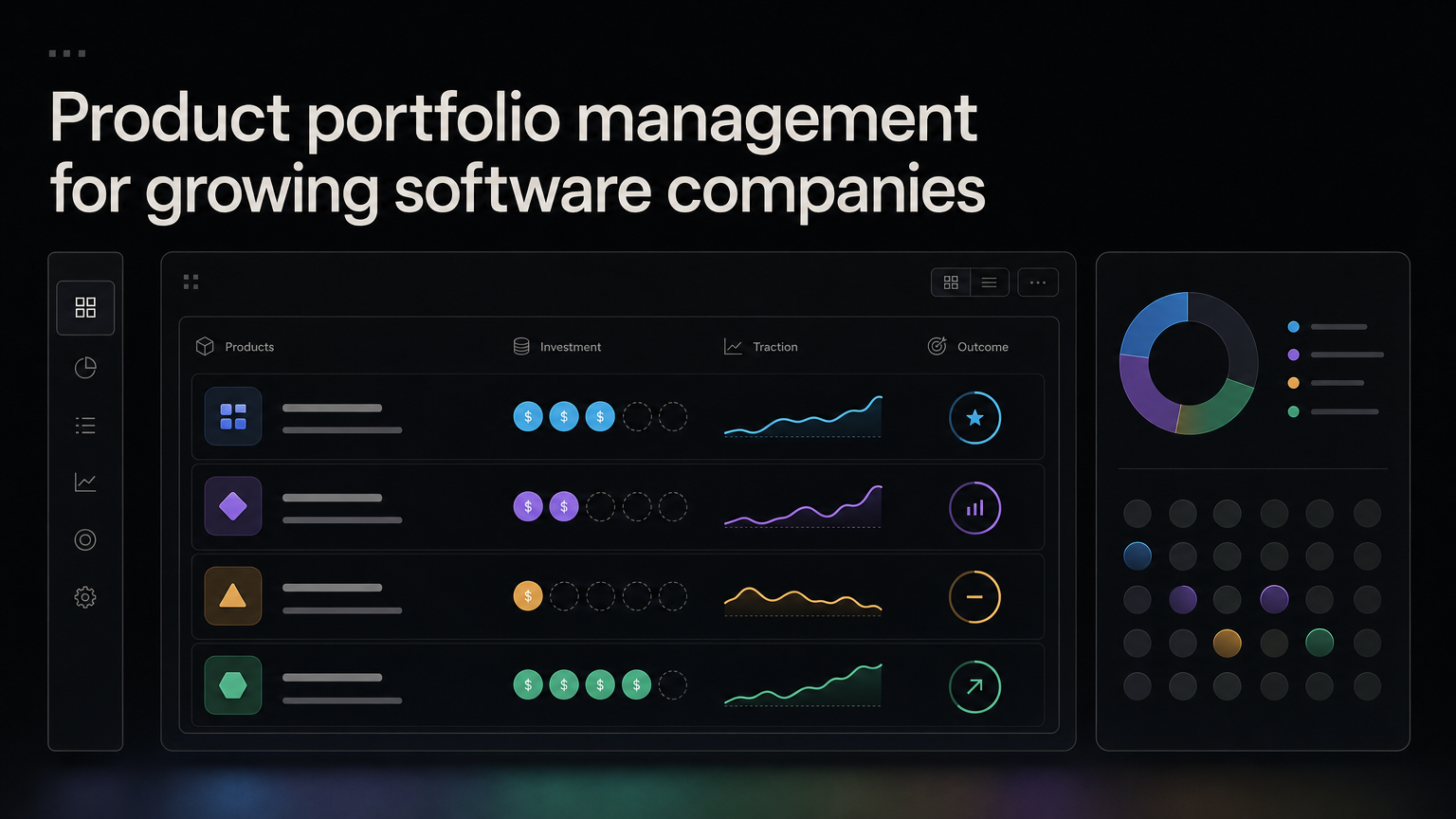
Product portfolio management is the process of deciding how a company invests across several products, platforms, or major product lines.
Each product may have a sensible roadmap. The portfolio question is harder: should the company keep funding all of them?
Give every product a role
A product might:
- Drive current revenue
- Enter a new market
- Retain an important segment
- Provide shared infrastructure
- Test a future business
- Wind down while customers migrate
Without a declared role, every team argues for growth and every roadmap looks equally urgent.
Compare outcomes, not feature counts
Review each product using a common set of questions:
- Which customer and problem does it serve?
- What outcome is expected this year?
- What evidence shows demand?
- What does it cost to operate and improve?
- What risk does it create?
- How does it support the rest of the portfolio?
A small infrastructure product may be valuable because three revenue products depend on it. A busy roadmap does not automatically signal a healthy investment.
Keep customer feedback separated and connected
Use distinct feedback boards or categories for each product so demand does not become a single noisy queue.
Then group cross-product themes. Customers may ask for shared identity, reporting, billing, or integrations across the portfolio. These themes can justify platform investment.
Make tradeoffs explicit
Portfolio planning should produce changes:
- Increase investment
- Maintain
- Merge
- Reposition
- Partner
- Retire
If every product remains a top priority, the review avoided its main job.
Align roadmaps to portfolio decisions
Once the investment decision is made, each product roadmap should show the outcomes that support it. Review portfolio assumptions quarterly and product evidence more frequently.
Tell affected customers early when a product is being merged or retired. Publish migration steps, dates, and updates in one reliable place.
Feedboard can give each product a focused feedback space and roadmap while keeping customer communication consistent. Start with Feedboard.
Build a portfolio inventory
Create one page for every product or major platform:
Target customer:
Customer problem:
Strategic role:
Annual objective:
Revenue and cost:
Adoption and retention:
Key dependencies:
Main risks:
Current investment:
Next review:
Use the same definitions across products. One team should not report active users while another reports registered accounts and a third reports transactions.
Assign a strategic role
Common roles include:
- Core: supports current customers and revenue
- Growth: expected to expand an established market
- Venture: tests a new customer or business model
- Platform: provides shared capability to other products
- Defensive: protects retention, compliance, or a strategic position
- Sunset: maintained while customers migrate
A product can change roles, but it should not claim all of them. The role determines the evidence and investment expected.
Compare products with a balanced scorecard
Review five dimensions:
| Dimension | Question |
|---|---|
| Customer value | Does it solve a frequent, important problem? |
| Business value | Does it produce revenue, retention, or strategic leverage? |
| Strategic fit | Does it support the company’s chosen direction? |
| Evidence | How reliable are adoption, feedback, and market signals? |
| Cost and risk | What does it take to operate, improve, and secure? |
Scores can summarize the review, but written reasoning should remain visible. A shared platform may have low direct revenue and high portfolio value.
Allocate by scenario
Do not spread people evenly because every product has a roadmap.
Build three scenarios:
- Maintain: fund reliability, support, and contractual work.
- Focus: increase investment in the strongest opportunity and slow another.
- Transform: merge, sell, partner, or retire a product.
For each scenario, state the expected outcome, main risk, reversibility, and work displaced.
Worked example
A company operates:
- A mature analytics product generating most revenue
- A new collaboration add-on with strong adoption
- A legacy reporting tool used by a small set of large accounts
- A shared identity platform
The portfolio review may decide:
- Keep analytics as core and focus on retention.
- Treat collaboration as growth and increase discovery capacity.
- Move reporting to sunset with a two-quarter migration.
- Fund identity as platform work because every product depends on it.
The decision is not that one product is “bad.” Each receives investment appropriate to its role.
Connect customer evidence correctly
Maintain separate product areas so feedback does not collapse into one queue. Then identify cross-product themes such as permissions, search, billing, or reporting.
Compare unique accounts, target segments, workarounds, and product behavior. A high-volume request in a sunset product may support migration rather than new development.
Decide whether to merge or retire
Consider retirement when adoption declines, strategic fit disappears, maintenance risk grows, or another product solves the same job better.
A retirement plan needs:
- Decision and owner
- Affected accounts
- Replacement or export path
- Communication dates
- Contract and support plan
- Data retention and deletion rules
- Migration assistance
- Final service date
Tell customers early and update them regularly. A quiet removal turns a portfolio decision into a trust problem.
Run the portfolio review
Quarterly is a useful default. Review product teams more frequently, but avoid changing portfolio roles every month.
The meeting should produce explicit decisions:
- Increase investment
- Maintain
- Reduce
- Merge
- Partner
- Retire
- Gather named missing evidence
If every product remains the top priority, the review did not allocate anything.
Measure portfolio health
Track concentration of revenue, cost to operate, adoption by target segment, product-level retention, shared capability reuse, roadmap delivery, and risk exposure.
Also measure the cost of complexity: duplicated engineering, overlapping sales messages, fragmented data, and customers buying several products to finish one job.
Frequently asked questions
How many products require portfolio management?
The need appears when leaders allocate shared people or money across distinct products, platforms, or markets. Even two products can create portfolio tradeoffs.
Should every product have its own roadmap?
Yes, when each serves a distinct customer outcome. The portfolio view stays above them and explains roles and investment.
How should experimental products be judged?
Use learning milestones, not mature revenue targets. Define the assumption, evidence required, spending limit, and decision date.
Who owns portfolio decisions?
Executive leadership owns investment choices. Product leaders supply customer, market, delivery, and risk evidence. Finance helps make cost and return comparable.
Portfolio decision record
After every review, publish an internal record:
Product and strategic role:
Evidence considered:
Investment decision:
People and budget:
Expected outcome:
Leading indicators:
Risks:
Work reduced or stopped:
Next review:
Customer communication required:
The record prevents teams from receiving an investment change without its reason. It also allows leadership to evaluate whether assumptions proved true.
Portfolio management becomes credible when it stops work as well as starts it. Name the projects, maintenance commitments, or market efforts that will receive less capacity, and plan customer communication before the effect becomes visible.
Review whether teams actually received the capacity the decision assigned. A portfolio plan without corresponding staffing and budget is only a presentation.