%20--%3e%3cdefs%3e%3cstyle%3e%20.st0%20{%20fill:%20%23fff;%20}%20%3c/style%3e%3c/defs%3e%3cpath%20class='st0'%20d='M37.06,124.64c1.42-.39,3.06.14,4.14.77,29.56,17.44,67.54,6.48,83.47-23.79,9.31-17.68,10.16-36.97,1.54-55.34-1.29-2.76.63-5.66,3.07-6.48,2.76-.91,5.34.33,6.56,2.99,7.71,16.78,8.53,35.39,2.51,52.8-14.32,41.46-61.44,61.08-100.66,39.6l-28.54,8.18c-1.53.44-3.51-.85-4.32-1.78-1.07-1.23-1.51-2.99-1.06-4.68l7.42-27.48C1.75,93.06-1.86,75.29,2.43,56.85,9.85,24.85,36.89,1.27,70.09.31c14.91-.43,29.09,3.99,41.7,12.54l-.36-5.47c-.17-2.66,1.42-4.88,3.81-5.4,2.05-.44,5.56.58,5.97,3.25,1.09,7.06,1.8,14.07,2.44,21.4.2,2.3-2.47,4.71-4.65,4.73l-18.11.08c-2.8,0-5.09-1.59-5.5-4.35-.35-2.36,1.31-5.56,4.1-5.59l6.44-.08C76.96,1.23,36.92,10.4,19.4,41.02c-11.87,20.72-11.49,44.19,1.31,64.59.85,1.31,1.36,2.49.93,4.03l-5.58,20.83,20.99-5.85.02.02Z'/%3e%3cpath%20class='st0'%20d='M91.43,92.7c4.29,0,7.09-3.34,6.98-7.09-.11-4.05-3.59-7.03-7.8-6.51h-20.19l3.67-10.15,16.89-.03c3.39,0,5.97-2.47,6.48-5.72.33-2.08-.3-4.22-1.58-5.63-1.45-1.59-3.44-2.1-5.64-2.1l-14.72.05,3.1-10.18c4.29-.19,8.41-.33,12.75-.13,7.66.35,14.32,5.25,16.03,12.72,1.36,5.97-.65,11.99-5.85,15.54,3.21,2.02,5.5,4.76,6.49,8.59,2.55,9.85-4.33,20.06-14.94,20.56l-32.37.2,3.73-10.07,9.74-.08h17.21v.02Z'/%3e%3cpath%20class='st0'%20d='M68.08,68.96l-3.36,10.12-18.41.03-.06,23.7h-10.38v-56.96c0-.5,1.61-.71,2.14-.71h6.97l27.17-.02-3.18,10.34-22.63.14-.03,13.33,21.78.05v-.02Z'/%3e%3c/svg%3e)
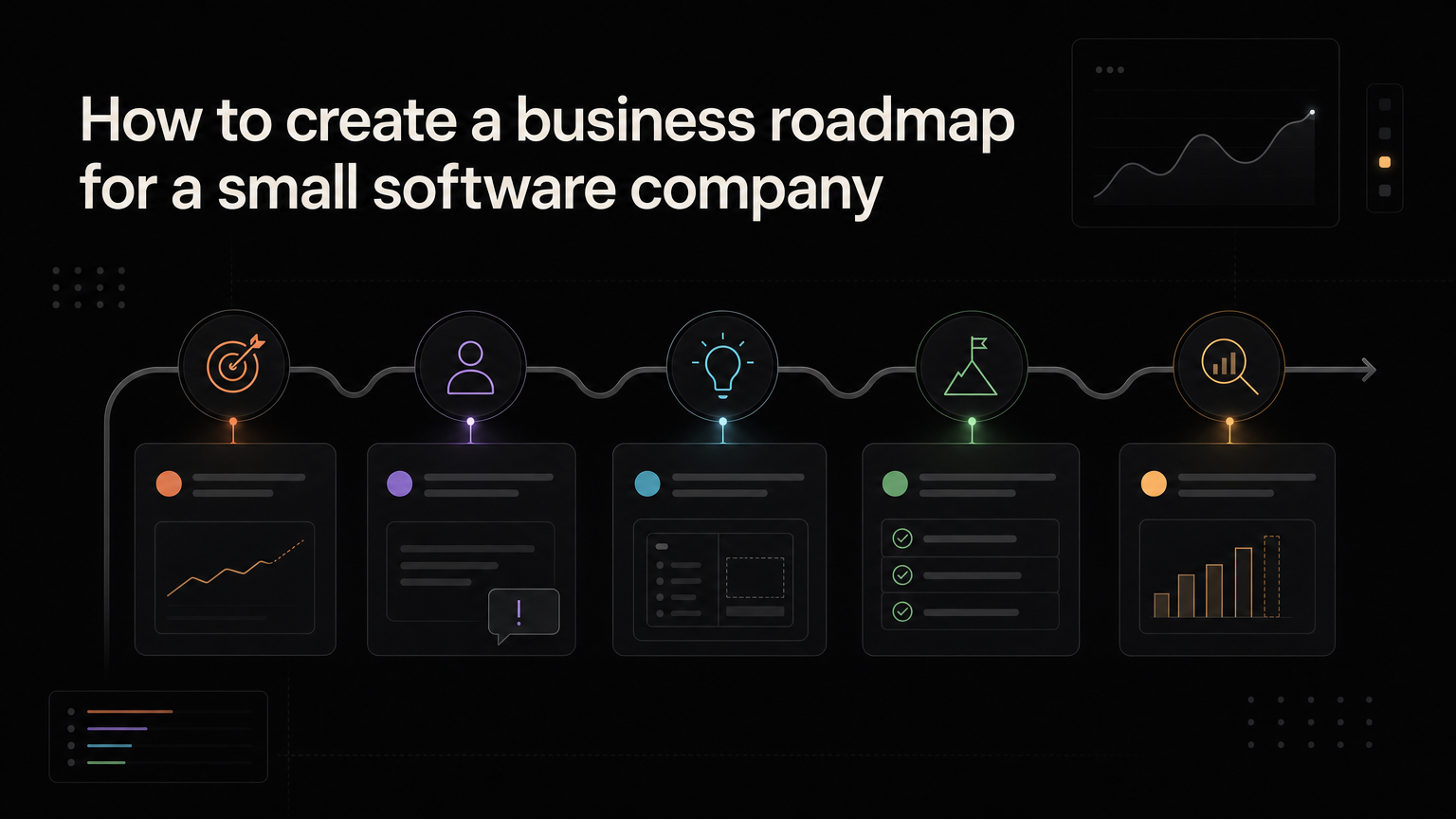
A business roadmap shows how a company plans to move from its current position toward a small number of goals.
It is lighter than a business plan and broader than a product roadmap. It connects company outcomes to the bets, capabilities, and milestones needed to reach them.
For a small software company, one page is often enough.
Business roadmap vs. product roadmap
A business roadmap covers company-level change:
- Market or customer focus
- Revenue and retention goals
- Product bets
- Team and operational capabilities
- Partnerships or channels
A product roadmap focuses on customer problems and product outcomes.
The two should connect. If the business goal is to retain larger customers, the product roadmap may include reliability, permissions, or reporting problems supported by customer evidence.
Do not turn either roadmap into a list of every task. Use a project tool for delivery details.
Start with the current state
Write a short baseline:
Customers:
Core product:
Revenue model:
Main acquisition channel:
Retention or usage pattern:
Biggest constraint:
Use facts where possible. “Growth is slow” is vague. “Trial volume is healthy, but only 18% of new workspaces reach the first shared result” points to a problem the roadmap can address.
Choose one to three outcomes
Examples:
- Improve eight-week retention from 52% to 60%
- Reach $50,000 in monthly recurring revenue
- Reduce founder-led onboarding from three hours to thirty minutes per account
- Establish one repeatable acquisition channel
The roadmap should show what the company is trying to change, not just what it plans to build.
Name the assumptions
Every strategy depends on beliefs:
If new teams invite a colleague in their first week, they are more likely to retain.
If agencies can share reports with clients, more will upgrade.
Write these assumptions beside the outcome. They tell the team what must be tested.
Organize work into strategic bets
A bet is a coordinated attempt to change an outcome.
For example:
Outcome
Improve retention among small agencies.
Bet
Make client collaboration part of the core workflow.
Evidence
Agency customers repeatedly request guest access and share screenshots outside the product.
Milestones
- Interview ten agency accounts
- Test a guest-access prototype
- Release a limited beta
- Measure adoption and retention
This is more useful than listing “guest permissions” without the reason or expected result.
Add owners and review dates
Every outcome and bet needs one owner, even when several people contribute.
Set a review date based on the learning cycle. A product experiment might be reviewed in six weeks. A channel bet may need a quarter.
At the review, choose:
- Continue
- Expand
- Change
- Stop
Stopping a weak bet is progress. The roadmap should make that decision visible.
Include customer evidence
Connect product bets to the customer feedback behind them.
Useful evidence includes repeated requests, churn conversations, observed workarounds, support volume, usage patterns, and prototype tests.
Votes can show demand, but the roadmap should also capture who is asking, why the problem matters, and how it supports the business outcome.
A one-page business roadmap template
| Section | What to include |
|---|---|
| Current state | Baseline metrics and main constraint |
| Outcomes | One to three measurable company results |
| Assumptions | Beliefs that must be true |
| Strategic bets | Coordinated ways to test those beliefs |
| Customer evidence | Feedback and behavior supporting each bet |
| Milestones | Learning and delivery checkpoints |
| Owner | One accountable person |
| Review date | When the company will continue, change, or stop |
Keep detailed tasks elsewhere. The roadmap should remain readable in a short meeting.
Review the roadmap when evidence changes
Do not update it for every new idea. Review it on a regular cadence and when a major assumption fails.
Ask:
- Are the outcomes still the right ones?
- What did we learn?
- Which bets are working?
- What should stop?
- What has customer feedback changed?
- What will we do next?
Publish the relevant product portion to customers when transparency will help. Keep financial, competitive, or sensitive company details private.
Feedboard helps small software teams connect customer requests to a public product roadmap and share the releases that follow. Start with Feedboard.
Connect outcomes to resources
For every strategic bet, record the people, money, technology, and leadership attention required.
Small teams often plan as if the same engineer can lead onboarding, enterprise security, mobile development, and infrastructure at once. A roadmap is useful when it makes that conflict visible.
Use:
Bet:
Expected outcome:
Owner:
People required:
Cash or vendor cost:
Key dependency:
Work displaced:
Review date:
Add risk and reversibility
Identify:
- Market risk: customers may not value the outcome
- Execution risk: the team may not deliver it
- Financial risk: cost or payback may be wrong
- Operational risk: support or reliability may suffer
- Strategic risk: the bet may distract from the chosen market
Prefer small, reversible tests when evidence is weak. Commit larger resources as the assumption strengthens.
Worked example
A five-person SaaS company wants to grow agency revenue.
Baseline:
- Agencies are 30% of accounts and 48% of revenue.
- Retention is strong after clients begin receiving reports.
- Setup requires founder help.
- Agencies repeatedly request external sharing.
Outcome:
Increase activated agency accounts from 40% to 55% and reduce founder onboarding to thirty minutes by December 31.
Bets:
- Simplify agency setup and templates.
- Test a client-sharing workflow.
- Create self-serve migration guidance.
The company postpones a general mobile redesign because it does not support the current outcome. The tradeoff is part of the roadmap.
Build milestones around learning
Use milestones such as:
- Ten recent-event interviews completed
- Prototype tested with five target accounts
- First successful pilot
- Guardrail met
- Rollout expanded
- Outcome reviewed
“Feature 50% complete” reports effort, not whether the bet is working.
Create a communication layer
Internal roadmap detail can include financial assumptions, staffing, risks, and alternatives.
The customer-facing product roadmap should show safe outcomes, broad status, and meaningful updates. Investors or advisors may need a third view focused on company milestones.
Do not expose confidential company strategy merely because a product roadmap is public.
Monthly operating review
Review:
- Outcome against baseline
- Leading indicators
- Customer evidence
- Spending and capacity
- Risks and guardrails
- What was learned
- Continue, revise, or stop
Update the roadmap after the decision, not before the discussion.
Scenario planning
For uncertain bets, prepare:
- Expected case
- Upside case
- Downside case
- Trigger that changes the plan
If a channel test produces fewer than ten qualified trials after six weeks, the team may stop rather than extending it indefinitely.
Roadmap health metrics
Track outcomes with owners, bets with defined assumptions, milestones completed, decisions made on time, resources allocated, and customer updates published.
Avoid measuring the roadmap by number of cards shipped.
Frequently asked questions
How far ahead should a small company plan?
Use clearer commitments for the current quarter and broader bets beyond it. Uncertainty increases with time.
Should revenue targets appear on the product roadmap?
Keep revenue on the business roadmap. Link product outcomes to it internally without turning public roadmap cards into sales targets.
What if priorities change mid-quarter?
Record the evidence, displaced work, and new decision. Change is acceptable; invisible change destroys alignment.
Who maintains the roadmap?
The founder or business owner can maintain a small-company roadmap, with named owners supplying evidence and updates.