%20--%3e%3cdefs%3e%3cstyle%3e%20.st0%20{%20fill:%20%23fff;%20}%20%3c/style%3e%3c/defs%3e%3cpath%20class='st0'%20d='M37.06,124.64c1.42-.39,3.06.14,4.14.77,29.56,17.44,67.54,6.48,83.47-23.79,9.31-17.68,10.16-36.97,1.54-55.34-1.29-2.76.63-5.66,3.07-6.48,2.76-.91,5.34.33,6.56,2.99,7.71,16.78,8.53,35.39,2.51,52.8-14.32,41.46-61.44,61.08-100.66,39.6l-28.54,8.18c-1.53.44-3.51-.85-4.32-1.78-1.07-1.23-1.51-2.99-1.06-4.68l7.42-27.48C1.75,93.06-1.86,75.29,2.43,56.85,9.85,24.85,36.89,1.27,70.09.31c14.91-.43,29.09,3.99,41.7,12.54l-.36-5.47c-.17-2.66,1.42-4.88,3.81-5.4,2.05-.44,5.56.58,5.97,3.25,1.09,7.06,1.8,14.07,2.44,21.4.2,2.3-2.47,4.71-4.65,4.73l-18.11.08c-2.8,0-5.09-1.59-5.5-4.35-.35-2.36,1.31-5.56,4.1-5.59l6.44-.08C76.96,1.23,36.92,10.4,19.4,41.02c-11.87,20.72-11.49,44.19,1.31,64.59.85,1.31,1.36,2.49.93,4.03l-5.58,20.83,20.99-5.85.02.02Z'/%3e%3cpath%20class='st0'%20d='M91.43,92.7c4.29,0,7.09-3.34,6.98-7.09-.11-4.05-3.59-7.03-7.8-6.51h-20.19l3.67-10.15,16.89-.03c3.39,0,5.97-2.47,6.48-5.72.33-2.08-.3-4.22-1.58-5.63-1.45-1.59-3.44-2.1-5.64-2.1l-14.72.05,3.1-10.18c4.29-.19,8.41-.33,12.75-.13,7.66.35,14.32,5.25,16.03,12.72,1.36,5.97-.65,11.99-5.85,15.54,3.21,2.02,5.5,4.76,6.49,8.59,2.55,9.85-4.33,20.06-14.94,20.56l-32.37.2,3.73-10.07,9.74-.08h17.21v.02Z'/%3e%3cpath%20class='st0'%20d='M68.08,68.96l-3.36,10.12-18.41.03-.06,23.7h-10.38v-56.96c0-.5,1.61-.71,2.14-.71h6.97l27.17-.02-3.18,10.34-22.63.14-.03,13.33,21.78.05v-.02Z'/%3e%3c/svg%3e)
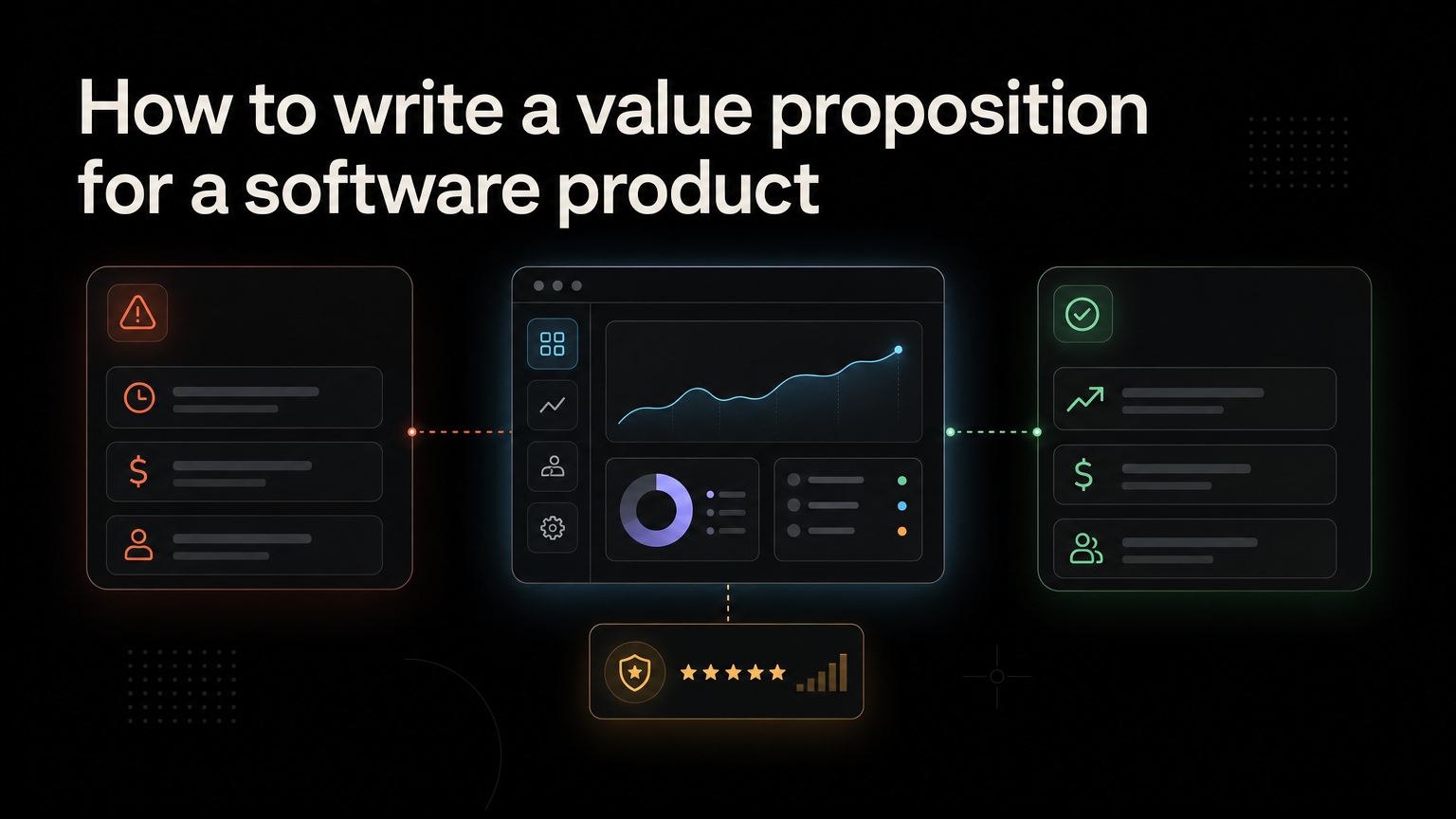
A value proposition is the clearest explanation of why a specific customer should choose your product.
It is not a slogan. It should tell the reader who the product is for, what problem it solves, what changes after using it, and why the claim is believable.
The four parts of a useful value proposition
1. The customer
Name a group that recognizes itself.
“Modern businesses” is too broad. “Small software teams collecting product feedback across support and sales” gives you something concrete to write for.
2. The problem
Describe the situation in the customer’s language.
Feature requests are scattered across tickets, calls, and spreadsheets.
Avoid abstract phrases such as “unlock your potential.” A customer should be able to point to the problem in their working day.
3. The outcome
Explain what becomes easier, faster, safer, or possible.
Keep every request in one place and show customers what the team plans to build.
An outcome is more useful than a feature list because it tells the reader what the features are for.
4. The reason to believe
Support the claim with evidence or a specific mechanism.
This may be:
- A product demonstration
- A measurable customer result
- A distinctive workflow
- A useful free plan
- An integration that removes manual work
- A guarantee or trial
Do not invent proof. If the product is new, be specific about how it works.
A value proposition template
Use this as a draft:
For [specific customer] who [problem], [product] helps them [outcome] by [distinct mechanism or proof].
Example:
For small software teams whose customer requests are scattered across conversations, Feedboard provides one place to collect feedback, share roadmap progress, and publish product updates.
The sentence is a working tool. Your homepage version can be shorter.
Start with customer language
Look at:
- Sales call notes
- Support tickets
- Feedback posts
- Cancellation reasons
- Customer interviews
- Search terms
Collect phrases customers repeat. Pay attention to the moment the problem becomes urgent and the workaround they use.
Do not copy one person’s wording blindly. Look for patterns across customers who fit the market you want to serve.
Features are supporting evidence
A common software value proposition is a row of capabilities:
Boards, voting, roadmaps, changelogs, and integrations.
That tells the reader what exists but not why it matters.
Connect the capabilities to a result:
Turn scattered product requests into a feedback board, move selected ideas onto a public roadmap, and tell requesters when the work ships.
The features now describe a coherent workflow.
Test whether the message is clear
Show the headline and subheading to someone in the target market for five seconds. Then ask:
- Who is it for?
- What does it help them do?
- Why might they choose it?
If the answers vary widely, the message is trying to cover too much.
You can also test behavior:
- Do the right visitors start a trial?
- Do sales calls begin with a correct understanding?
- Do new customers use the workflow the message promises?
- Are people disappointed by something the copy implied?
A value proposition is not successful because the team likes the words. It works when it attracts the right customer with an accurate expectation.
Common mistakes
Claiming a universal benefit
“Save time and grow faster” could describe almost any software. Name the task and the result.
Leading with technology
Customers rarely need “an AI-powered platform.” They may need feedback from fifty conversations grouped without hours of manual work. Explain the job before the mechanism.
Stacking superlatives
“The easiest, fastest, most powerful solution” asks the reader to trust unsupported claims. A concrete workflow is more persuasive.
Hiding the audience
Broad copy feels safe but makes it hard for anyone to recognize a strong fit. Specificity may reduce total clicks while improving the customers who continue.
Keep the promise aligned with the product
Review your value proposition as the product and market change. Compare it with recent feedback and the reasons customers stay.
The message should describe the value customers can receive today, not a roadmap aspiration.
Feedboard helps software products and services collect customer ideas, share a roadmap, and publish updates from one place. See Feedboard.
Gather message evidence
Create a language bank from:
- Recent sales calls
- Support and onboarding conversations
- Feedback posts
- Cancellation notes
- Customer reviews
- Search queries
- Successful customer descriptions
For every phrase, record who said it, their situation, and the outcome they wanted. A memorable quote from an outlier should not define positioning.
Build a message hierarchy
Primary value
The main outcome for the main customer.
Supporting benefits
Two or three results that make the primary value believable.
Mechanism
How the product creates those results.
Proof
Customer evidence, product demonstration, or a specific operational fact.
Objection handling
Clarify setup, price, migration, risk, or audience limitations.
This hierarchy gives the homepage, onboarding, sales deck, and product updates a shared message without forcing identical copy.
Compare weak and strong examples
Weak:
The all-in-one platform that unlocks customer-centric growth.
The audience, problem, and product behavior are missing.
Stronger:
Collect product requests in one board, show customers what is planned, and notify them when the work ships.
The reader can understand the workflow and decide whether it matches their need.
Write for a narrow first audience
Suppose the product serves software founders, product managers, and service companies.
The broad message may become vague. Choose the highest-priority landing page audience:
For small software teams whose requests are scattered across support and sales, Feedboard keeps feedback, roadmap decisions, and release updates connected.
Separate pages can explain use for agencies or services without weakening the main message.
Add proof without exaggeration
Early products can use:
- A real interactive demo
- Setup time measured honestly
- A transparent free plan
- Specific workflow screenshots
- Direct customer quotes with permission
- Public changelog activity
Do not invent customer results or use “trusted by” language without meaningful adoption.
Test message comprehension
Run a five-second test and ask:
- What does the product do?
- Who is it for?
- What problem does it solve?
- What would you expect after clicking?
Then test behavior:
- Qualified signup rate
- Activation by message variant
- Sales-call understanding
- Reasons visitors do not continue
- Mismatch between promise and product use
Click-through alone can reward curiosity rather than fit.
Use a message-testing plan
Audience:
Current message:
Observed misunderstanding:
New claim:
Proof shown:
Primary behavior:
Guardrail:
Test period:
Result:
Change one important claim at a time when traffic allows. For low-traffic products, use interviews, sales conversations, and onboarding behavior rather than waiting months for statistical certainty.
Keep product and message aligned
Review copy when the target customer, pricing, core workflow, or strongest outcome changes.
Compare the homepage claim with:
- What activated customers actually do
- What retained customers value
- What support repeatedly explains
- What the roadmap prioritizes
- What the product can deliver today
Remove claims that describe an aspiration rather than the current product.
Frequently asked questions
Is a tagline the value proposition?
No. A tagline may be memorable; the full value proposition explains audience, problem, outcome, and proof.
How many benefits should appear above the fold?
Lead with one main outcome and enough mechanism to make it credible. Supporting benefits can follow.
Should competitor names appear?
Comparison pages can address alternatives. The primary value proposition should stand on the customer’s problem.
How often should messaging change?
Change when evidence shows misunderstanding or the product strategy changes, not because the team is bored with the words.