%20--%3e%3cdefs%3e%3cstyle%3e%20.st0%20{%20fill:%20%23fff;%20}%20%3c/style%3e%3c/defs%3e%3cpath%20class='st0'%20d='M37.06,124.64c1.42-.39,3.06.14,4.14.77,29.56,17.44,67.54,6.48,83.47-23.79,9.31-17.68,10.16-36.97,1.54-55.34-1.29-2.76.63-5.66,3.07-6.48,2.76-.91,5.34.33,6.56,2.99,7.71,16.78,8.53,35.39,2.51,52.8-14.32,41.46-61.44,61.08-100.66,39.6l-28.54,8.18c-1.53.44-3.51-.85-4.32-1.78-1.07-1.23-1.51-2.99-1.06-4.68l7.42-27.48C1.75,93.06-1.86,75.29,2.43,56.85,9.85,24.85,36.89,1.27,70.09.31c14.91-.43,29.09,3.99,41.7,12.54l-.36-5.47c-.17-2.66,1.42-4.88,3.81-5.4,2.05-.44,5.56.58,5.97,3.25,1.09,7.06,1.8,14.07,2.44,21.4.2,2.3-2.47,4.71-4.65,4.73l-18.11.08c-2.8,0-5.09-1.59-5.5-4.35-.35-2.36,1.31-5.56,4.1-5.59l6.44-.08C76.96,1.23,36.92,10.4,19.4,41.02c-11.87,20.72-11.49,44.19,1.31,64.59.85,1.31,1.36,2.49.93,4.03l-5.58,20.83,20.99-5.85.02.02Z'/%3e%3cpath%20class='st0'%20d='M91.43,92.7c4.29,0,7.09-3.34,6.98-7.09-.11-4.05-3.59-7.03-7.8-6.51h-20.19l3.67-10.15,16.89-.03c3.39,0,5.97-2.47,6.48-5.72.33-2.08-.3-4.22-1.58-5.63-1.45-1.59-3.44-2.1-5.64-2.1l-14.72.05,3.1-10.18c4.29-.19,8.41-.33,12.75-.13,7.66.35,14.32,5.25,16.03,12.72,1.36,5.97-.65,11.99-5.85,15.54,3.21,2.02,5.5,4.76,6.49,8.59,2.55,9.85-4.33,20.06-14.94,20.56l-32.37.2,3.73-10.07,9.74-.08h17.21v.02Z'/%3e%3cpath%20class='st0'%20d='M68.08,68.96l-3.36,10.12-18.41.03-.06,23.7h-10.38v-56.96c0-.5,1.61-.71,2.14-.71h6.97l27.17-.02-3.18,10.34-22.63.14-.03,13.33,21.78.05v-.02Z'/%3e%3c/svg%3e)
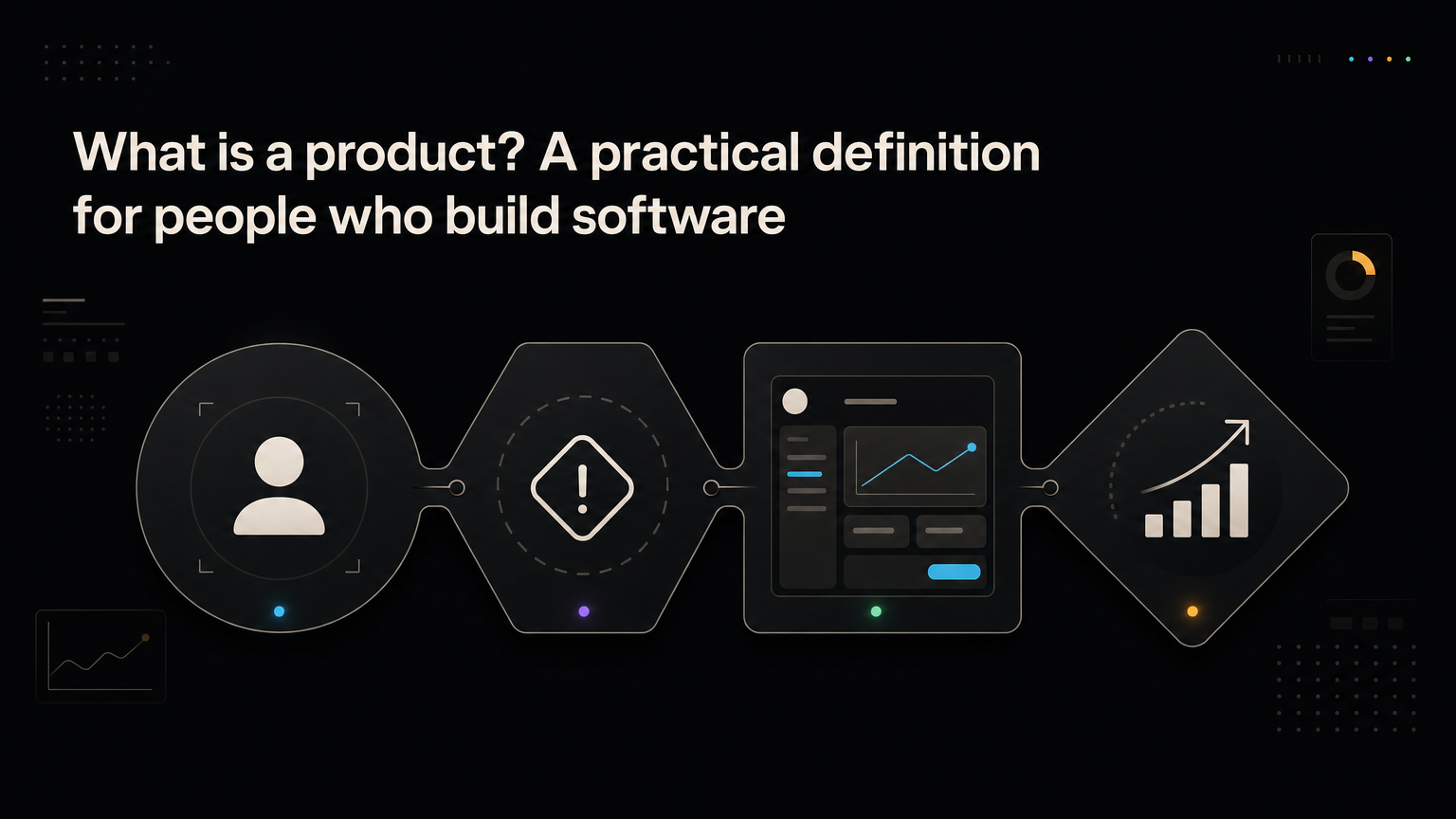
A product is a repeatable way to help a specific customer make progress on a problem.
That definition is deliberately stricter than “something a company sells.” It includes the customer, the job, the experience, and the system that keeps delivering the result.
Software is part of the product. The product also includes onboarding, pricing, support, documentation, reliability, and the expectations you set.
Product, project, and service
These terms overlap, but the distinction helps.
A product
A product is designed for repeated use by a defined market. The team improves it over time and makes tradeoffs across many customers.
Examples include an accounting app, a developer API, or a scheduling platform.
A project
A project has a specific result and an end. Building a new billing system is a project. The billing system customers continue to use is part of the product.
A service
A service uses people and process to deliver an outcome. Consulting and managed support are services.
Many businesses combine the models. A software product may include onboarding services. A service business may package part of its method into a repeatable product.
The five parts of a product
1. A defined customer
“Everyone” is not a useful customer definition.
A product team needs to know whose problem it is solving: independent designers, finance teams at large companies, developers building mobile apps, or a more precise group.
The definition can widen later. At the start, clarity helps you choose what to build and what to ignore.
2. A meaningful problem
A product competes with the customer’s current behavior, including doing nothing.
The problem must be painful, frequent, expensive, risky, or connected to a strong desire. A clever feature without a meaningful problem is a demo.
Describe the problem without mentioning your solution:
Small agencies lose track of client approvals across email threads.
That is easier to investigate than:
Agencies need an AI approval dashboard.
3. An outcome
Customers buy progress.
The agency may want approvals in one day instead of one week, fewer missed comments, or a clear record of who accepted the work. The outcome gives the team something to measure.
Features are possible ways to produce that outcome. They are not the outcome themselves.
4. A complete experience
The product experience starts before the first login and continues after the task is complete.
It includes:
- Discovering and understanding the product
- Signing up or buying
- Reaching the first useful result
- Completing the core job
- Getting help
- Receiving updates
- Leaving or exporting data
A powerful feature with confusing onboarding can still be a weak product.
5. A sustainable delivery system
The business must be able to deliver the outcome repeatedly.
That includes pricing, costs, support load, security, reliability, and a way to keep learning. If every new customer requires custom development, you may have a valuable service, but you do not yet have a scalable software product.
Products change as teams learn
The first version is a hypothesis.
Teams learn from:
- What customers ask for
- What they use
- Where they stop
- What they pay for
- Why they leave
- Which workarounds they invent
Feedback and behavior serve different purposes. Analytics shows what happened. Customer conversations help explain why. A feedback board reveals recurring requests and gives the team people to contact for deeper research.
How to tell whether an idea is becoming a product
Look for evidence of repetition.
- Similar customers describe the same problem.
- They already spend time or money on a workaround.
- A small version produces a useful outcome.
- People return to use it.
- Some customers will pay enough to support delivery.
- The team can serve the next customer without rebuilding everything.
One enthusiastic conversation is encouraging. Repeated behavior is stronger.
Product development is a loop
A simple product loop is:
- Choose a customer and problem.
- Describe the outcome.
- Build the smallest useful test.
- Observe behavior and collect feedback.
- Decide what to improve, remove, or stop.
- Tell customers what changed.
The final step keeps customers involved and improves the next round of feedback.
A product is a promise you keep repeatedly
The interface may change. Features will come and go. The product remains understandable when the customer, problem, and outcome stay clear.
Feedboard helps software teams collect product feedback, show what they plan to improve, and publish what shipped. Start a free feedback board.
Products operate at several layers
Core value
The customer outcome that makes the product worth choosing.
Capability
The workflows that produce that outcome.
Experience
Onboarding, interaction, reliability, help, and communication.
Business
Pricing, acquisition, delivery cost, support, and retention.
Operating system
The team, technology, partners, policies, and learning process that keep the product working.
A feature change can affect every layer. Adding enterprise permissions changes interface, support, security responsibility, pricing, and sales.
Product vs. feature
A feature performs a specific function. It becomes product value only when customers discover, understand, and use it to achieve an outcome.
Teams often ship a feature and measure completion. Product work continues through adoption, support, feedback, maintenance, and eventual removal.
Product lifecycle
Discovery
Identify customer, problem, demand, and business assumptions.
Introduction
Deliver a narrow outcome, observe use, and establish onboarding and support.
Growth
Improve repeatability, acquisition, collaboration, reliability, and economics.
Maturity
Protect core value, simplify complexity, serve segments deliberately, and manage operational risk.
Renewal or retirement
Reposition, rebuild, merge, or retire when the market, technology, or strategy changes.
The stage should influence metrics and roadmap choices. An early product needs evidence and repeat use; a mature product may focus on retention, reliability, and portfolio fit.
Connect desirability, feasibility, and viability
A product must be:
- Desirable: customers value the outcome
- Feasible: the team can deliver it safely and reliably
- Viable: the business can sustain delivery
- Usable: customers can reach the outcome
Strength in one dimension does not compensate permanently for failure in another.
Worked example
An agency reporting tool begins as a manual service. Customers send data, and the founder prepares a weekly client report.
The service validates the problem and desired outcome. A repeatable software product emerges when:
- Agencies can connect data without custom work.
- Templates handle common reporting jobs.
- Account managers produce reports themselves.
- Clients receive a reliable view.
- Pricing covers infrastructure and support.
- The next agency can onboard without rebuilding the system.
Automation alone does not create the product; repeatable value and sustainable delivery do.
Product evidence
Use:
- Recent customer behavior
- Repeated workarounds
- Activation and retention
- Support and feedback themes
- Willingness to pay
- Delivery cost and reliability
- Customer outcomes
Keep product analytics and customer feedback connected. Metrics show the event; customer evidence helps explain it.
Diagnostic questions
Who receives the value?
What problem occurs today?
What outcome do they seek?
What do they use instead?
What is the smallest complete experience?
Why will they choose and keep using it?
Can we deliver it repeatedly?
How will we learn and communicate changes?
If the team cannot answer, the uncertainty belongs in discovery rather than a larger feature backlog.
Frequently asked questions
Can a service be a product?
Yes, when the service offers a repeatable outcome to a defined market. Software is not required.
Is a platform one product?
It may support several products or be a product for developers. Define customer and outcome rather than relying on architecture.
Who owns the product?
A product manager or founder may coordinate decisions, but engineering, design, support, sales, and operations all shape the delivered experience.
When is a product finished?
Usually when it is retired. Products require ongoing reliability, learning, communication, and adaptation.