%20--%3e%3cdefs%3e%3cstyle%3e%20.st0%20{%20fill:%20%23fff;%20}%20%3c/style%3e%3c/defs%3e%3cpath%20class='st0'%20d='M37.06,124.64c1.42-.39,3.06.14,4.14.77,29.56,17.44,67.54,6.48,83.47-23.79,9.31-17.68,10.16-36.97,1.54-55.34-1.29-2.76.63-5.66,3.07-6.48,2.76-.91,5.34.33,6.56,2.99,7.71,16.78,8.53,35.39,2.51,52.8-14.32,41.46-61.44,61.08-100.66,39.6l-28.54,8.18c-1.53.44-3.51-.85-4.32-1.78-1.07-1.23-1.51-2.99-1.06-4.68l7.42-27.48C1.75,93.06-1.86,75.29,2.43,56.85,9.85,24.85,36.89,1.27,70.09.31c14.91-.43,29.09,3.99,41.7,12.54l-.36-5.47c-.17-2.66,1.42-4.88,3.81-5.4,2.05-.44,5.56.58,5.97,3.25,1.09,7.06,1.8,14.07,2.44,21.4.2,2.3-2.47,4.71-4.65,4.73l-18.11.08c-2.8,0-5.09-1.59-5.5-4.35-.35-2.36,1.31-5.56,4.1-5.59l6.44-.08C76.96,1.23,36.92,10.4,19.4,41.02c-11.87,20.72-11.49,44.19,1.31,64.59.85,1.31,1.36,2.49.93,4.03l-5.58,20.83,20.99-5.85.02.02Z'/%3e%3cpath%20class='st0'%20d='M91.43,92.7c4.29,0,7.09-3.34,6.98-7.09-.11-4.05-3.59-7.03-7.8-6.51h-20.19l3.67-10.15,16.89-.03c3.39,0,5.97-2.47,6.48-5.72.33-2.08-.3-4.22-1.58-5.63-1.45-1.59-3.44-2.1-5.64-2.1l-14.72.05,3.1-10.18c4.29-.19,8.41-.33,12.75-.13,7.66.35,14.32,5.25,16.03,12.72,1.36,5.97-.65,11.99-5.85,15.54,3.21,2.02,5.5,4.76,6.49,8.59,2.55,9.85-4.33,20.06-14.94,20.56l-32.37.2,3.73-10.07,9.74-.08h17.21v.02Z'/%3e%3cpath%20class='st0'%20d='M68.08,68.96l-3.36,10.12-18.41.03-.06,23.7h-10.38v-56.96c0-.5,1.61-.71,2.14-.71h6.97l27.17-.02-3.18,10.34-22.63.14-.03,13.33,21.78.05v-.02Z'/%3e%3c/svg%3e)
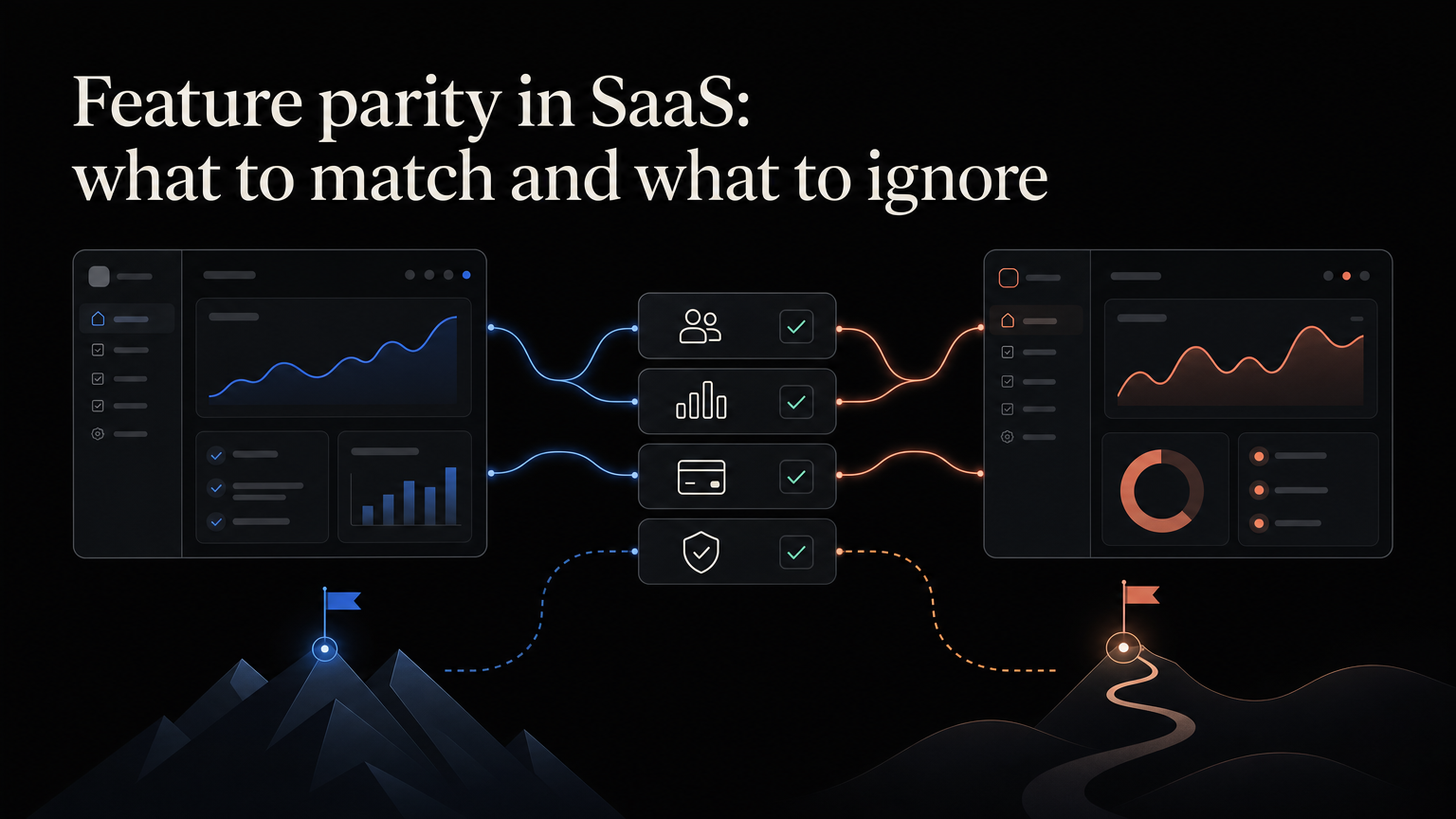
Feature parity means offering the capabilities customers consider comparable to another product.
It can remove a genuine buying objection. It can also trap your team in a race where the competitor chooses your roadmap.
Start with the customer decision
Do not ask, “Does our competitor have this?”
Ask:
- Does the missing capability block our target customer?
- Is it required to complete the core job?
- How often does it appear in lost deals or churn?
- Is the request really for the same implementation?
Customers may name a competitor feature because it is familiar. Investigate the outcome they need.
Separate three kinds of parity
Table stakes
These are capabilities customers assume will exist: basic security, data export, or permissions for a team product. Missing them can prevent evaluation.
Workflow parity
The competitor supports a job your target customer needs. You may need to solve the job, but not copy the interface.
Checklist parity
A feature appears on comparison pages but has little effect on real use. Building it may make sales collateral easier while adding product complexity.
Use evidence before copying
Collect the linked feedback, affected accounts, deal notes, and current workarounds. Prototype your own approach with the customers who raised the problem.
Score the opportunity using strategy, impact, reach, evidence, effort, and maintenance cost. Include what will be delayed.
Know when to say no
Skip parity when the feature serves a different market, conflicts with your product’s simplicity, or requires a long-term capability you do not want to own.
A clear limitation can strengthen positioning:
We are designed for small product teams, so we do not include portfolio planning across hundreds of products.
Close the request honestly
If parity work is planned, connect the request to the roadmap. If it is declined, explain the product direction rather than leaving the idea under review forever.
Competitive awareness is useful. Competitive obedience is not.
Feedboard gives teams one place to connect competitor-related requests to customer evidence and roadmap decisions. Track product feedback with Feedboard.
Run a parity audit
Create an inventory of capabilities mentioned in competitive evaluations, lost deals, churn conversations, and customer requests.
For each item, record:
Capability:
Customer job:
Target segment:
Accounts requesting it:
Current workaround:
Deal or retention impact:
Competitors offering it:
Our strategic position:
Estimated build and maintenance cost:
Confidence:
Decision:
Do not begin with a competitor pricing page alone. Comparison grids show availability, not whether customers receive value.
Classify the gap
Use four categories:
Required foundation
The capability is necessary for trust, compliance, migration, or the core job. Examples may include data export, account security, accessibility, or permissions.
Customer-workflow gap
Target customers repeatedly need an outcome the product cannot support. Solve the job in a way that fits your product rather than copying an interface.
Segment-specific need
The capability matters to one valuable segment but would add complexity for everyone. Consider plan limits, an integration, or a focused workflow.
Checklist noise
The item appears in evaluations but has weak evidence of use or business impact. Document it and decline or monitor it.
Use a decision matrix
| Demand | Strategic fit | Decision |
|---|---|---|
| High | High | Research and prioritize |
| High | Low | Revisit positioning or find a partner |
| Low | High | Test the underlying opportunity |
| Low | Low | Decline or monitor |
Add effort and confidence before committing. High demand based on two large but unusual prospects may be less reliable than moderate demand across the intended market.
Build, buy, integrate, or explain
Building is only one response.
- Build when the capability is central to the product experience.
- Buy when a proven component reduces undifferentiated work.
- Integrate when another product already owns the workflow.
- Use services when the need is valuable but not repeatable.
- Explain the limitation when it protects a deliberate product choice.
Every option has maintenance, security, and support costs.
Worked example
A lightweight project tool repeatedly loses enterprise evaluations because it lacks SAML SSO.
The team confirms that security review blocks deals in its new target segment. SSO is not a daily user feature, but it is a purchase requirement. The audit shows:
- Eight blocked opportunities in six months
- Two existing customers using manual account controls
- Strong fit with the enterprise strategy
- High implementation and ongoing security responsibility
The team buys an identity component, adds SSO to the enterprise plan, documents setup, and measures completed security reviews. It does not copy the competitor’s entire administration suite.
Protect differentiation
Write down what the product deliberately does differently:
- Fewer configuration choices
- Faster setup
- A narrower customer
- A stronger workflow
- A different pricing model
- Better integration with an existing tool
Parity work should not erase the reason customers choose you.
Set a complexity budget. For every capability added, identify setup, navigation, documentation, support, and long-term maintenance it creates.
Measure the outcome
After parity work ships, track:
- Previously blocked deals that progress
- Adoption among requesting customers
- Retention or expansion in the target segment
- Support and implementation cost
- Usage after three or six months
- Product complexity introduced
If customers demanded a feature but rarely use it, investigate whether the item was a buying checkbox, onboarding failed, or the wrong problem was solved.
Communicate decisions
For planned gaps, avoid exact dates until scope is understood. For declined items, explain the product direction:
We are not building a full document editor. Our focus is review and approval, and we integrate with tools designed for document creation.
This answer is clearer than leaving the request indefinitely under review.
Frequently asked questions
Must a new product match the market leader?
No. It must solve a valuable job well enough for a chosen customer. Some foundational expectations may still be unavoidable.
How often should parity be reviewed?
Review strategic gaps quarterly and evidence from deals or churn continuously. Do not react to every competitor release.
Should competitor names appear on the roadmap?
Describe the customer outcome publicly. Keep competitive analysis and positioning notes internal.
Can parity become differentiation?
Yes, when you solve the same required job with a simpler, faster, or more appropriate workflow for your segment.
Quarterly parity review template
New gaps reported:
Repeated deal or churn evidence:
Foundation requirements:
Workflow gaps:
Checklist-only requests:
Capabilities shipped:
Adoption and commercial outcome:
Complexity added:
Decisions to revisit:
Include product, sales, support, security, and engineering evidence. The purpose is to make a small number of explicit build, buy, integrate, explain, or decline decisions.
End the review by restating the product’s deliberate differences. A parity program without a clear boundary gradually converts a focused product into an expensive copy of the largest competitor.
Assign every monitored gap a revisit trigger or close it. An unowned “maybe later” list still consumes attention and can repeatedly distort sales and roadmap conversations.