%20--%3e%3cdefs%3e%3cstyle%3e%20.st0%20{%20fill:%20%23fff;%20}%20%3c/style%3e%3c/defs%3e%3cpath%20class='st0'%20d='M37.06,124.64c1.42-.39,3.06.14,4.14.77,29.56,17.44,67.54,6.48,83.47-23.79,9.31-17.68,10.16-36.97,1.54-55.34-1.29-2.76.63-5.66,3.07-6.48,2.76-.91,5.34.33,6.56,2.99,7.71,16.78,8.53,35.39,2.51,52.8-14.32,41.46-61.44,61.08-100.66,39.6l-28.54,8.18c-1.53.44-3.51-.85-4.32-1.78-1.07-1.23-1.51-2.99-1.06-4.68l7.42-27.48C1.75,93.06-1.86,75.29,2.43,56.85,9.85,24.85,36.89,1.27,70.09.31c14.91-.43,29.09,3.99,41.7,12.54l-.36-5.47c-.17-2.66,1.42-4.88,3.81-5.4,2.05-.44,5.56.58,5.97,3.25,1.09,7.06,1.8,14.07,2.44,21.4.2,2.3-2.47,4.71-4.65,4.73l-18.11.08c-2.8,0-5.09-1.59-5.5-4.35-.35-2.36,1.31-5.56,4.1-5.59l6.44-.08C76.96,1.23,36.92,10.4,19.4,41.02c-11.87,20.72-11.49,44.19,1.31,64.59.85,1.31,1.36,2.49.93,4.03l-5.58,20.83,20.99-5.85.02.02Z'/%3e%3cpath%20class='st0'%20d='M91.43,92.7c4.29,0,7.09-3.34,6.98-7.09-.11-4.05-3.59-7.03-7.8-6.51h-20.19l3.67-10.15,16.89-.03c3.39,0,5.97-2.47,6.48-5.72.33-2.08-.3-4.22-1.58-5.63-1.45-1.59-3.44-2.1-5.64-2.1l-14.72.05,3.1-10.18c4.29-.19,8.41-.33,12.75-.13,7.66.35,14.32,5.25,16.03,12.72,1.36,5.97-.65,11.99-5.85,15.54,3.21,2.02,5.5,4.76,6.49,8.59,2.55,9.85-4.33,20.06-14.94,20.56l-32.37.2,3.73-10.07,9.74-.08h17.21v.02Z'/%3e%3cpath%20class='st0'%20d='M68.08,68.96l-3.36,10.12-18.41.03-.06,23.7h-10.38v-56.96c0-.5,1.61-.71,2.14-.71h6.97l27.17-.02-3.18,10.34-22.63.14-.03,13.33,21.78.05v-.02Z'/%3e%3c/svg%3e)
Feature voting looks wonderfully simple. Customers suggest ideas, people vote, and the product team builds the winners.
That last step is where the model breaks.
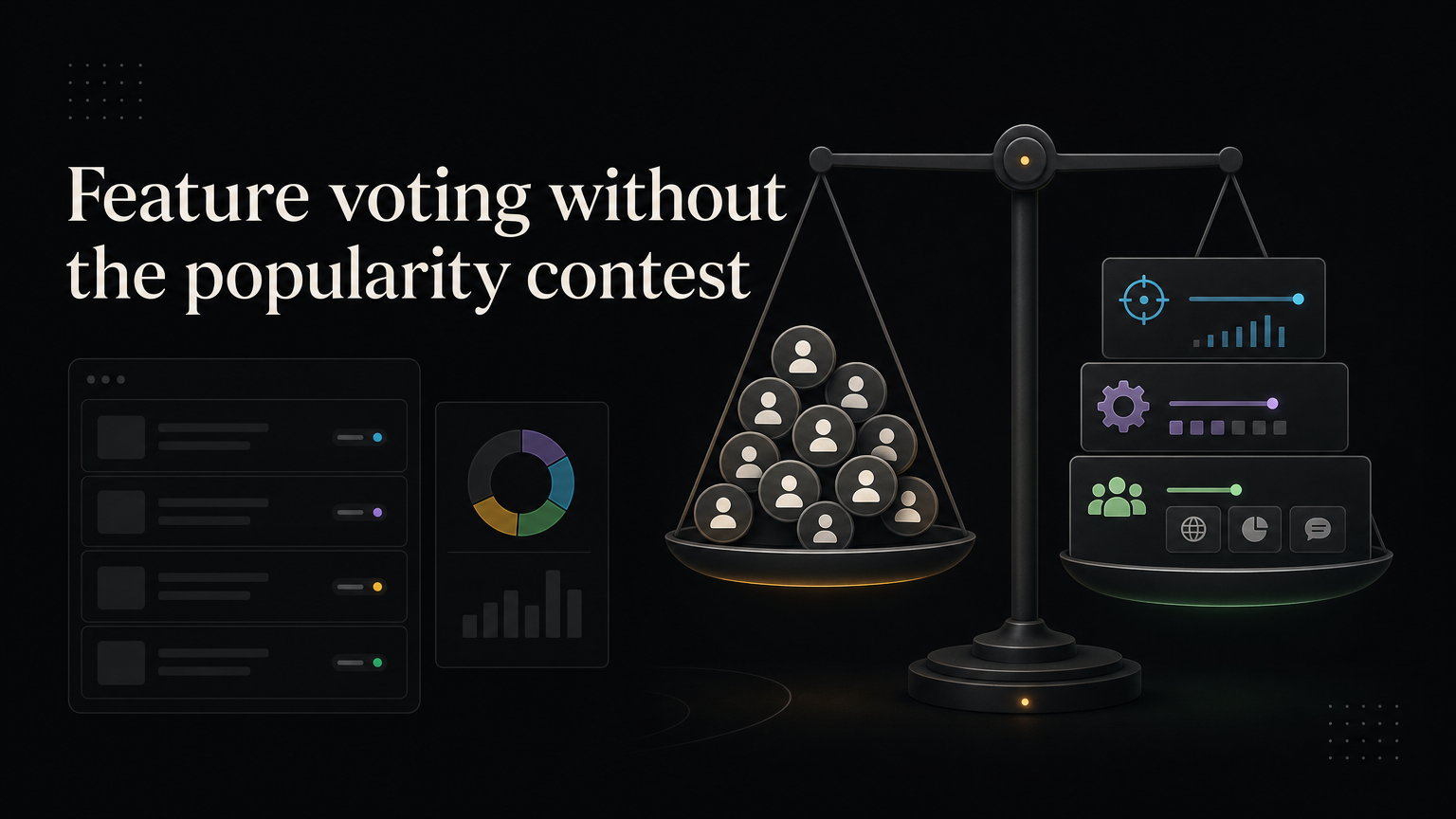
Votes are evidence of interest. They are not a roadmap, a promise, or a substitute for understanding the problem. A useful voting board makes demand visible while leaving the decision with the product team.
What feature voting can tell you
A vote can answer one narrow question: would this person like the team to consider this idea?
Across a large enough group, votes can reveal:
- Requests that keep appearing across accounts
- Differences between customer segments
- Topics worth researching
- Customers to contact for interviews or beta testing
- Existing ideas that deserve a fresh review
Voting works best as a discovery tool. It helps the team decide where to investigate, not what to build automatically.
What a vote cannot tell you
A vote does not explain urgency, frequency, willingness to pay, implementation cost, or strategic fit.
Two customers may vote for the same request for entirely different reasons. One wants an export to satisfy a monthly compliance process. The other wants to explore their data once. The same button may not solve both problems.
Votes are also shaped by visibility. Older requests collect more votes. Requests with clearer titles attract more attention. Vocal users share links. A newly launched idea can be more important than a five-year-old post with a large total.
Treat the count as a clue, not a verdict.
Seven feature voting practices that work
1. Explain what voting means
Put a short policy next to the board:
Votes help us understand demand. We also consider customer context, product strategy, impact, and effort. A vote does not guarantee that an idea will be built.
This sets an honest expectation before a popular request becomes an accidental promise.
2. Ask for context with the vote
Give customers room to describe what they are trying to do. A useful prompt is:
What would this help you accomplish, and what do you do today?
Comments turn a count into research material. They also help other customers decide whether an existing request matches their problem.
3. Merge duplicates quickly
Duplicate posts divide votes and make the board harder to search.
Use plain titles based on the problem or outcome. Merge similar suggestions, preserve the original comments, and redirect people to the main request. A clean board produces better data because customers can find the right place to add their voice.
4. Look at who voted
One total can hide several different stories.
Break votes down by the segments that matter to your business: free and paid, small teams and enterprise accounts, new customers and long-term users, or a specific industry.
Segmentation is not a license to ignore smaller customers. It helps you understand whether a request serves your intended market and current strategy.
5. Review trends, not only totals
The speed of new votes can matter more than the lifetime count.
Ask:
- Did interest rise after a product change?
- Are several related requests pointing to one deeper problem?
- Is demand concentrated in a specific workflow?
- Are churned customers mentioning the same gap?
A cluster of small signals may deserve more attention than one broad, vague request.
6. Respond before you build
Customers value a clear response even when the answer is no.
Use statuses such as under review, planned, in progress, shipped, and not planned. Add a short public explanation when appropriate. “We are focusing on improving the core reporting workflow this quarter” is more useful than silence.
Do not leave every request in “under review.” That status becomes a waiting room nobody trusts.
7. Close the loop when something ships
Notify voters when a related feature is released. Link to a short changelog entry that explains what changed and how to use it.
This does more than celebrate a launch. It proves that participating in the board is worth the customer’s time.
A simple voting review
For each request under review, write down:
| Input | Question |
|---|---|
| Demand | How many relevant customers have asked for this? |
| Problem | How painful and frequent is the underlying job? |
| Strategy | Does it support what the product is trying to become? |
| Impact | What customer or business outcome could improve? |
| Effort | What is the smallest useful version, and what will it cost? |
| Confidence | What evidence do we have beyond the vote count? |
You do not need a complicated formula. The value comes from applying the same questions and recording the reasoning.
Should votes be public?
Public counts create social proof and help customers discover existing requests. They can also invite campaigning and make a decision feel more political.
Hidden counts reduce those effects but make the board less transparent.
A reasonable default for an early product is public posts and votes, paired with a clear voting policy. If your product handles sensitive enterprise requests, use a private board or restrict access to authenticated customers.
The rule to remember
Let customers vote on importance. Do not ask them to run your product strategy.
Feedboard gives customers a clear place to suggest and support ideas while your team keeps control of the roadmap. Create a feedback board with Feedboard.
Worked vote analysis
A request has 120 votes. At first it looks dominant.
Segmentation shows:
- 80 votes came from inactive free accounts after a community campaign.
- 25 came from active small businesses.
- 15 came from enterprise administrators.
- Enterprise comments describe a regulatory blocker.
The team does not discard the total or automatically build the request. It separates the regulated workflow, interviews administrators, and evaluates a focused solution.
Moderate campaigns and manipulation
Rate-limit abusive activity, require appropriate authentication, and document how duplicate or fraudulent votes are handled.
Organic sharing is not inherently bad. The team should be able to distinguish campaign-driven volume from repeated product evidence.
Review voting-board health
Track:
- Unique active customers voting
- Votes with comments or linked context
- Duplicate requests
- Segment distribution
- Time to first response
- Stale reviewed posts
- Requesters notified after decisions
Do not reward total vote growth without considering participation quality.
Frequently asked questions
Should customers have unlimited votes?
Unlimited voting is simple. Limited votes force relative priority but add complexity. Choose based on the behavior you want.
Should employees vote?
Record internal importance separately or label internal votes clearly. Do not let proxy voting obscure customer demand.
What if the highest-voted request is declined?
Explain the strategic or practical reason, acknowledge the affected workflow, and preserve the evidence for future review.
Voting-policy template
Votes help us see customer interest and find people for research. We also consider the affected customer, problem severity, strategy, evidence, effort, risk, and opportunity cost. A vote does not guarantee delivery. We update reviewed requests when our decision changes.
Publish the policy beside the board and apply it consistently.