%20--%3e%3cdefs%3e%3cstyle%3e%20.st0%20{%20fill:%20%23fff;%20}%20%3c/style%3e%3c/defs%3e%3cpath%20class='st0'%20d='M37.06,124.64c1.42-.39,3.06.14,4.14.77,29.56,17.44,67.54,6.48,83.47-23.79,9.31-17.68,10.16-36.97,1.54-55.34-1.29-2.76.63-5.66,3.07-6.48,2.76-.91,5.34.33,6.56,2.99,7.71,16.78,8.53,35.39,2.51,52.8-14.32,41.46-61.44,61.08-100.66,39.6l-28.54,8.18c-1.53.44-3.51-.85-4.32-1.78-1.07-1.23-1.51-2.99-1.06-4.68l7.42-27.48C1.75,93.06-1.86,75.29,2.43,56.85,9.85,24.85,36.89,1.27,70.09.31c14.91-.43,29.09,3.99,41.7,12.54l-.36-5.47c-.17-2.66,1.42-4.88,3.81-5.4,2.05-.44,5.56.58,5.97,3.25,1.09,7.06,1.8,14.07,2.44,21.4.2,2.3-2.47,4.71-4.65,4.73l-18.11.08c-2.8,0-5.09-1.59-5.5-4.35-.35-2.36,1.31-5.56,4.1-5.59l6.44-.08C76.96,1.23,36.92,10.4,19.4,41.02c-11.87,20.72-11.49,44.19,1.31,64.59.85,1.31,1.36,2.49.93,4.03l-5.58,20.83,20.99-5.85.02.02Z'/%3e%3cpath%20class='st0'%20d='M91.43,92.7c4.29,0,7.09-3.34,6.98-7.09-.11-4.05-3.59-7.03-7.8-6.51h-20.19l3.67-10.15,16.89-.03c3.39,0,5.97-2.47,6.48-5.72.33-2.08-.3-4.22-1.58-5.63-1.45-1.59-3.44-2.1-5.64-2.1l-14.72.05,3.1-10.18c4.29-.19,8.41-.33,12.75-.13,7.66.35,14.32,5.25,16.03,12.72,1.36,5.97-.65,11.99-5.85,15.54,3.21,2.02,5.5,4.76,6.49,8.59,2.55,9.85-4.33,20.06-14.94,20.56l-32.37.2,3.73-10.07,9.74-.08h17.21v.02Z'/%3e%3cpath%20class='st0'%20d='M68.08,68.96l-3.36,10.12-18.41.03-.06,23.7h-10.38v-56.96c0-.5,1.61-.71,2.14-.71h6.97l27.17-.02-3.18,10.34-22.63.14-.03,13.33,21.78.05v-.02Z'/%3e%3c/svg%3e)
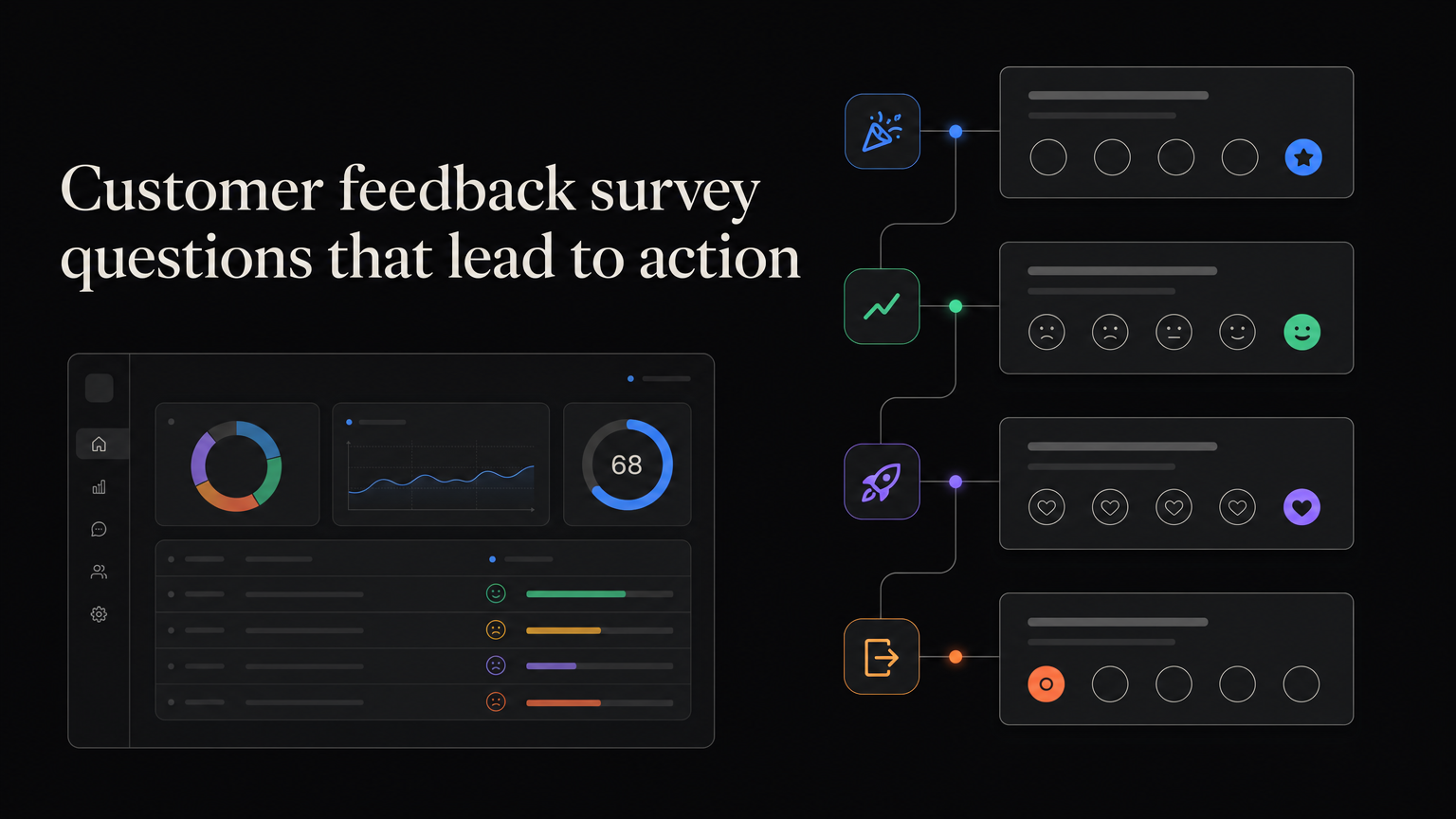
A useful survey is short, timely, and connected to a decision. Asking everything at once produces shallow answers and low completion.
After onboarding
- What were you hoping to complete today?
- Which step took longer than expected?
- What nearly stopped you from finishing setup?
- What did you expect to happen next?
During regular use
- What task do you complete most often?
- Which part still requires work outside the product?
- What is the most frustrating repeated step?
- If you could change one part of this workflow, what would it be?
After a feature release
- What were you trying to do with this feature?
- Were you able to complete it?
- What was unclear?
- What limitation prevents you from using it regularly?
At cancellation
- What is the main reason you are leaving?
- What will you use instead?
- Was there a specific event that led to the decision?
- What would have needed to change for you to stay?
For satisfaction or NPS
- How likely are you to recommend the product?
- What is the main reason for your score?
- Which result do you value most?
- What should we improve first?
Write neutral questions
Avoid:
How useful was our powerful new dashboard?
Use:
What, if anything, did the dashboard help you do?
Do not combine two questions or make every field required.
Decide before you send
Name the owner, review date, and action the answers may influence. Route product requests to the feedback board, urgent problems to support, and research candidates to the product team.
Feedboard gives survey insights a shared place to become feedback themes and roadmap decisions. Start with Feedboard.
Choose the sample deliberately
Survey responses are shaped by who receives the question. Define the relevant customer stage, behavior, plan, and time window. Compare respondents with the invited group before treating percentages as representative.
Keep the survey short
Use one primary question and one follow-up for an in-product prompt. Longer research belongs in an interview or scheduled survey with a clear reason.
Test the wording with colleagues who were not involved in writing it. If they interpret a question differently, customers will too.
Analyze open responses
Group comments by customer problem, workflow, segment, and severity. Preserve the original text. Count unique accounts rather than treating several responses from one company as separate demand.
Select representative customers for follow-up:
You mentioned that inviting a teammate was confusing. Could you walk me through the last time you tried?
Avoid survey mistakes
- Do not ask leading questions.
- Do not combine two topics in one question.
- Do not survey before customers receive value.
- Do not make every field mandatory.
- Do not launch without an owner and review date.
- Do not promise action on every suggestion.
Report back
Share what you heard, what the team will investigate, and what it will not change. When survey feedback leads to a release, notify the relevant respondents.
Closing the loop improves the quality of future surveys because customers see that detailed answers produce a response.
Match the method to the question
Use an in-product prompt for immediate workflow feedback, email for a defined customer group, and interviews when you need sequence and context.
A survey is good at finding patterns across a known audience. It is weaker at uncovering unknown problems because the questions reflect what the team already considered.
Design response options carefully
Use balanced scales with clearly described endpoints. Include “not applicable” when respondents may not have used the workflow.
Avoid overlapping choices such as “1–5 employees” and “5–10 employees.” Randomize answer order only when order could bias the result and the choices have no natural sequence.
Establish a baseline
If the survey measures change, keep the audience, timing, question wording, and channel consistent. A higher score after surveying only active customers is not evidence that the experience improved.
Record:
Survey purpose:
Audience and exclusions:
Trigger or send date:
Questions:
Invited:
Responses:
Response rate:
Owner:
Decision date:
Combine surveys with behavior
Customers may report that a feature is easy while abandoning it frequently. Others may criticize a workflow they depend on every day.
Compare responses with completion, frequency, support contact, and retention. Neither source automatically overrides the other.
Example: onboarding survey
Send after the customer reaches or abandons the first meaningful result:
- What were you trying to accomplish today?
- Were you able to complete it?
- Which step, if any, was unclear?
- What did you do outside the product?
- May we contact you for a fifteen-minute follow-up?
Branch follow-up questions based on completion rather than asking everyone the same long form.
Example: cancellation survey
Ask for the main reason, triggering event, replacement, and whether help could address an immediate issue. Keep cancellation easy; do not trap the customer behind required feedback.
Route bugs and billing problems to support immediately while preserving the research response.
Interpret response rates
Low response can result from poor timing, irrelevant questions, survey fatigue, or an audience that has already disengaged.
Report the response rate and invited audience beside percentages. Do not present ten responses as representative of thousands of customers without qualification.
Frequently asked questions
How many questions should a survey contain?
Use only questions connected to the decision. An in-product survey may have two; structured research may have ten with a clear time estimate.
Should incentives be used?
They can improve participation in longer research but may change who responds. Use a modest, audience-appropriate incentive and disclose it in analysis.
How often should customers be surveyed?
Set suppression rules across teams so the same person does not receive several surveys in a short period. Triggered relevance is more important than a universal cadence.
Survey reporting template
Decision the survey supports:
Audience and exclusions:
Invitation and response counts:
Response rate:
Collection period:
Question wording:
Results by relevant segment:
Open-response themes:
Limitations:
Decision and owner:
Customer follow-up:
Include the exact wording. Small changes can make results incomparable.
Protect customer privacy
Collect only data needed for analysis and follow-up. Restrict access to identifiable responses and define how long raw data is retained.
If answers may be shared with product, sales, or publicly, state that expectation. Remove personal or confidential details from examples.
Use a pilot
Send the survey to a small representative group first. Check completion time, misunderstood questions, broken branching, and whether response options cover real situations.
Revise before broad distribution. A large sample cannot repair a confusing question.
Close the research record
Archive the questionnaire, sample, results, analysis, decision, and messages sent afterward. This keeps future teams from repeating surveys and lets them compare a genuinely consistent measure.
Before closing, link product themes to their source responses and remove sensitive material from shared reports. Record who can access raw identifiable data.
A survey earns its place when the team can name the decision it changed, the uncertainty it reduced, or the customer problem it sent to a clear next step.