%20--%3e%3cdefs%3e%3cstyle%3e%20.st0%20{%20fill:%20%23fff;%20}%20%3c/style%3e%3c/defs%3e%3cpath%20class='st0'%20d='M37.06,124.64c1.42-.39,3.06.14,4.14.77,29.56,17.44,67.54,6.48,83.47-23.79,9.31-17.68,10.16-36.97,1.54-55.34-1.29-2.76.63-5.66,3.07-6.48,2.76-.91,5.34.33,6.56,2.99,7.71,16.78,8.53,35.39,2.51,52.8-14.32,41.46-61.44,61.08-100.66,39.6l-28.54,8.18c-1.53.44-3.51-.85-4.32-1.78-1.07-1.23-1.51-2.99-1.06-4.68l7.42-27.48C1.75,93.06-1.86,75.29,2.43,56.85,9.85,24.85,36.89,1.27,70.09.31c14.91-.43,29.09,3.99,41.7,12.54l-.36-5.47c-.17-2.66,1.42-4.88,3.81-5.4,2.05-.44,5.56.58,5.97,3.25,1.09,7.06,1.8,14.07,2.44,21.4.2,2.3-2.47,4.71-4.65,4.73l-18.11.08c-2.8,0-5.09-1.59-5.5-4.35-.35-2.36,1.31-5.56,4.1-5.59l6.44-.08C76.96,1.23,36.92,10.4,19.4,41.02c-11.87,20.72-11.49,44.19,1.31,64.59.85,1.31,1.36,2.49.93,4.03l-5.58,20.83,20.99-5.85.02.02Z'/%3e%3cpath%20class='st0'%20d='M91.43,92.7c4.29,0,7.09-3.34,6.98-7.09-.11-4.05-3.59-7.03-7.8-6.51h-20.19l3.67-10.15,16.89-.03c3.39,0,5.97-2.47,6.48-5.72.33-2.08-.3-4.22-1.58-5.63-1.45-1.59-3.44-2.1-5.64-2.1l-14.72.05,3.1-10.18c4.29-.19,8.41-.33,12.75-.13,7.66.35,14.32,5.25,16.03,12.72,1.36,5.97-.65,11.99-5.85,15.54,3.21,2.02,5.5,4.76,6.49,8.59,2.55,9.85-4.33,20.06-14.94,20.56l-32.37.2,3.73-10.07,9.74-.08h17.21v.02Z'/%3e%3cpath%20class='st0'%20d='M68.08,68.96l-3.36,10.12-18.41.03-.06,23.7h-10.38v-56.96c0-.5,1.61-.71,2.14-.71h6.97l27.17-.02-3.18,10.34-22.63.14-.03,13.33,21.78.05v-.02Z'/%3e%3c/svg%3e)
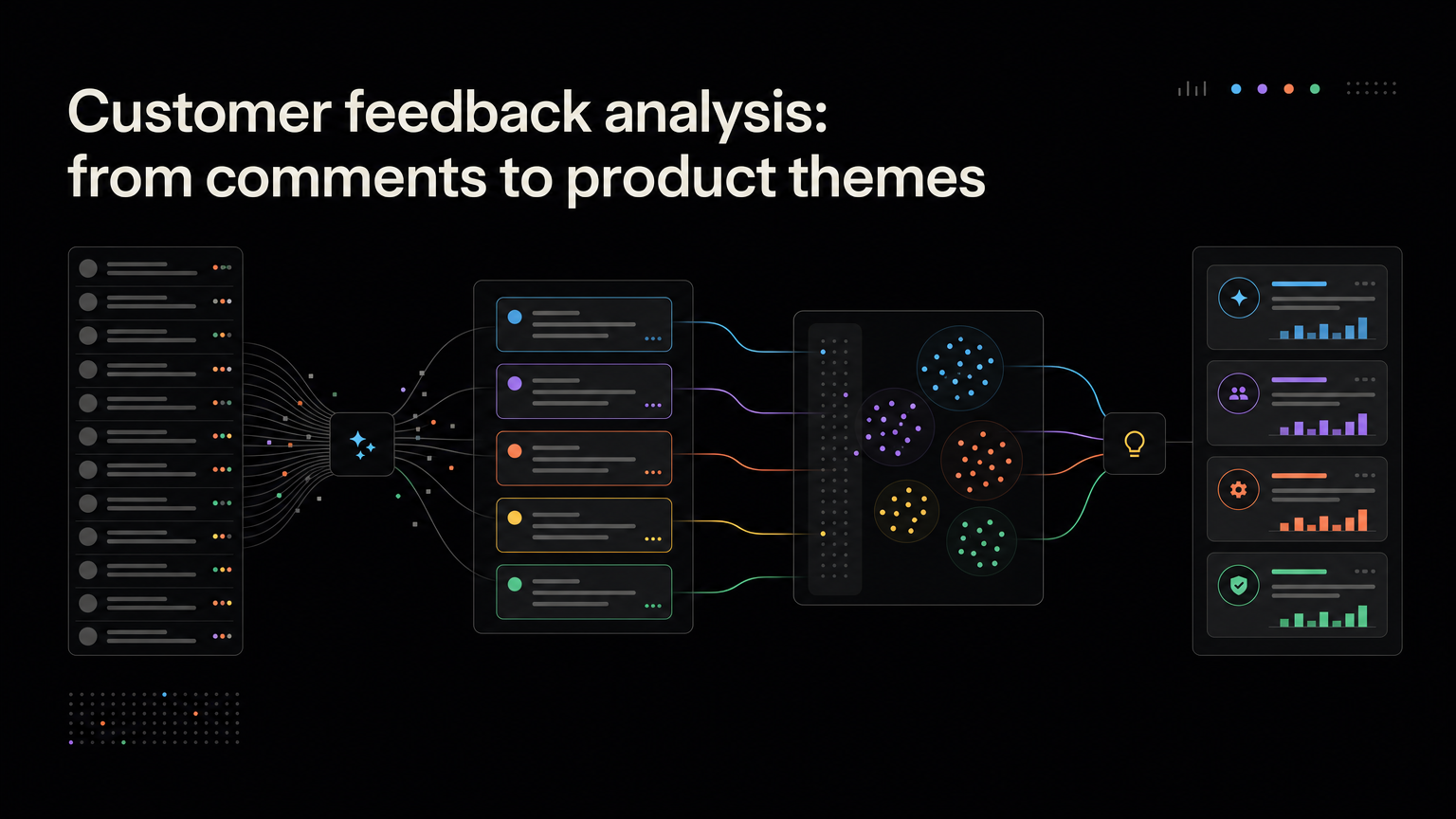
Feedback analysis turns individual comments into a view of recurring customer problems.
The goal is not a colorful tag chart. It is enough evidence to decide what to investigate, fix, or decline.
Clean the input
Remove spam, merge duplicates, and separate bugs, questions, requests, praise, and complaints.
Keep the original comment and source. A rewritten summary can lose the customer’s exact situation.
Code by problem and workflow
Use tags such as:
- Onboarding
- Reporting
- Permissions
- Billing
- Mobile workflow
Add sentiment only when it helps. “Negative” is less useful than “cannot complete invoice export.”
Group into themes
A theme connects related comments to one customer problem:
Client-facing teams cannot share progress without giving full account access.
Link each underlying comment so the theme remains auditable.
Segment the evidence
Break themes down by plan, company size, lifecycle, role, or another meaningful attribute.
Twenty comments across random visitors can mean something different from five detailed reports among the customer segment your strategy targets.
Add behavior and business context
Compare the theme with usage, support volume, churn reasons, and sales notes. Feedback explains experience; behavior shows frequency and consequence.
Produce a decision-ready summary
Theme:
Who is affected:
Evidence count and period:
Representative examples:
Current workaround:
Observed impact:
Unknowns:
Recommended next step:
Review themes on a schedule. Archive those that no longer appear, but keep the historical decision.
Run the analysis as a decision process
Begin with a question such as “Why are agency accounts cancelling?” or “Which onboarding problem should we investigate next?” The question determines the sources, time period, and segments.
Choose a defined dataset. A quarterly review might combine support, feedback posts, sales notes, and cancellation comments from the previous ninety days. Do not mix years of historic requests with recent feedback without accounting for age.
Tag a sample before processing everything. Refine the definitions until two reviewers classify similar comments consistently. Then group the coded comments into problem statements that name the customer and workflow.
Quantify without distorting
Count unique customers, accounts, and mentions separately. Compare recent momentum as well as lifetime volume. A long-standing request will naturally have more total votes than a new problem.
Add behavior and business context:
- Usage and completion data
- Support volume
- Churn or renewal notes
- Deal blockers
- Workaround cost
- Strategic customer fit
Example
Twelve comments tagged “export” may contain three different jobs:
| Theme | Accounts | Next step |
|---|---|---|
| Schedule recurring reports | 5 | Prototype with three accounts |
| Export raw data for analysis | 4 | Assess formats and volume |
| Share a client-only view | 3 | Interview agency users |
One tag count would have hidden the distinction.
Report a useful result
For each theme, provide:
Problem and affected customer:
Sources and time period:
Unique accounts:
Representative examples:
Current workaround:
Observed impact:
Unknowns:
Recommended next step:
Link the summary to the original evidence. State limitations, especially when the sample is small or self-selected.
Common errors
Do not count duplicate channels as separate demand, let the most emotional comment define the theme, or treat silence as satisfaction. Customers may leave without submitting feedback.
Analysis ends with an owner and next step: research, design test, bug fix, documentation, monitoring, or a decision not to act.
Feedboard helps you merge similar requests, preserve customer context, and move strong themes toward the roadmap. Analyze feedback in Feedboard.
Create a coding guide
For each code, write a definition, inclusion rule, exclusion rule, and example.
Code: Reporting > Scheduled delivery
Include: Requests to send an existing report automatically on a cadence.
Exclude: Requests for new report types or one-time exports.
Example: “Email this dashboard to my client every Monday.”
Without exclusion rules, overlapping tags become impossible to compare.
Calibrate reviewers
Give two reviewers the same twenty comments. Compare product area, problem type, and theme.
Discuss disagreements and update definitions before coding hundreds of records. Repeat calibration when the product changes or new people join.
Do not seek perfect agreement on ambiguous language. Mark low-confidence items for follow-up.
Use a theme hierarchy
Structure analysis from broad to specific:
Product area: Reporting
Workflow: Sharing results
Problem theme: External recipients cannot access focused views
Possible solutions: Scheduled email, guest access, public link
Keep possible solutions below the problem. Otherwise the taxonomy will count requested implementations rather than customer jobs.
Compare cohorts
A theme can mean different things across:
- New and established customers
- Free and paid plans
- Administrators and daily users
- Small teams and enterprise accounts
- Active and churned customers
- Customers who adopted a feature and those who did not
State cohort sizes. A 50% rate among four responses is not equal to 50% among four hundred.
Weight without hiding evidence
You may add severity, revenue, frequency, or strategic-account context. Keep raw account counts visible.
A weighted score can help sort themes, but reviewers should still see why one account carries additional weight. Avoid formulas that silently make high-revenue customers the only product voice.
Add confidence
Label each theme:
- Low: one or two ambiguous reports
- Medium: repeated statements with some context
- High: repeated, observed workflows with measurable consequence
Confidence controls the next step. Low confidence calls for research, not automatic rejection.
Turn analysis into a research queue
For unresolved themes, select customers with recent examples and varied segments. Use focused interviews, prototype tests, or workflow observation.
Record the question the research must answer:
Do agency managers need scheduled delivery, or do clients need a persistent view they can open at any time?
Track decisions over time
A theme record should show:
- First and latest evidence
- Trend by period
- Research completed
- Decision and reason
- Roadmap link
- Release link
- Requesters notified
When a previously declined theme grows, the team can revisit it without repeating all prior analysis.
Analysis quality checklist
- Sources and dates are stated.
- Duplicates are controlled.
- Unique accounts are counted.
- Customer segments are visible.
- Original comments remain linked.
- Problem and solution are separated.
- Contradictory evidence is included.
- Limitations are written.
- An owner and next action exist.
Frequently asked questions
How often should feedback be analyzed?
Clean intake weekly and review major themes monthly or quarterly, depending on volume and product pace.
Is sentiment analysis enough?
No. Sentiment shows tone, not the workflow, consequence, or decision. Use it as one field.
Can analysis be automated?
Automation can summarize, suggest duplicates, and propose tags. Validate it against reviewed samples and keep humans responsible for decisions and sensitive context.
What if sources disagree?
Investigate audience and behavior. Support, sales, surveys, and product usage observe different parts of the customer experience.
Treat disagreement as a research lead. Write the competing explanations and identify the customer sample or behavioral evidence that would distinguish them. Do not average incompatible signals into one vague theme.