%20--%3e%3cdefs%3e%3cstyle%3e%20.st0%20{%20fill:%20%23fff;%20}%20%3c/style%3e%3c/defs%3e%3cpath%20class='st0'%20d='M37.06,124.64c1.42-.39,3.06.14,4.14.77,29.56,17.44,67.54,6.48,83.47-23.79,9.31-17.68,10.16-36.97,1.54-55.34-1.29-2.76.63-5.66,3.07-6.48,2.76-.91,5.34.33,6.56,2.99,7.71,16.78,8.53,35.39,2.51,52.8-14.32,41.46-61.44,61.08-100.66,39.6l-28.54,8.18c-1.53.44-3.51-.85-4.32-1.78-1.07-1.23-1.51-2.99-1.06-4.68l7.42-27.48C1.75,93.06-1.86,75.29,2.43,56.85,9.85,24.85,36.89,1.27,70.09.31c14.91-.43,29.09,3.99,41.7,12.54l-.36-5.47c-.17-2.66,1.42-4.88,3.81-5.4,2.05-.44,5.56.58,5.97,3.25,1.09,7.06,1.8,14.07,2.44,21.4.2,2.3-2.47,4.71-4.65,4.73l-18.11.08c-2.8,0-5.09-1.59-5.5-4.35-.35-2.36,1.31-5.56,4.1-5.59l6.44-.08C76.96,1.23,36.92,10.4,19.4,41.02c-11.87,20.72-11.49,44.19,1.31,64.59.85,1.31,1.36,2.49.93,4.03l-5.58,20.83,20.99-5.85.02.02Z'/%3e%3cpath%20class='st0'%20d='M91.43,92.7c4.29,0,7.09-3.34,6.98-7.09-.11-4.05-3.59-7.03-7.8-6.51h-20.19l3.67-10.15,16.89-.03c3.39,0,5.97-2.47,6.48-5.72.33-2.08-.3-4.22-1.58-5.63-1.45-1.59-3.44-2.1-5.64-2.1l-14.72.05,3.1-10.18c4.29-.19,8.41-.33,12.75-.13,7.66.35,14.32,5.25,16.03,12.72,1.36,5.97-.65,11.99-5.85,15.54,3.21,2.02,5.5,4.76,6.49,8.59,2.55,9.85-4.33,20.06-14.94,20.56l-32.37.2,3.73-10.07,9.74-.08h17.21v.02Z'/%3e%3cpath%20class='st0'%20d='M68.08,68.96l-3.36,10.12-18.41.03-.06,23.7h-10.38v-56.96c0-.5,1.61-.71,2.14-.71h6.97l27.17-.02-3.18,10.34-22.63.14-.03,13.33,21.78.05v-.02Z'/%3e%3c/svg%3e)
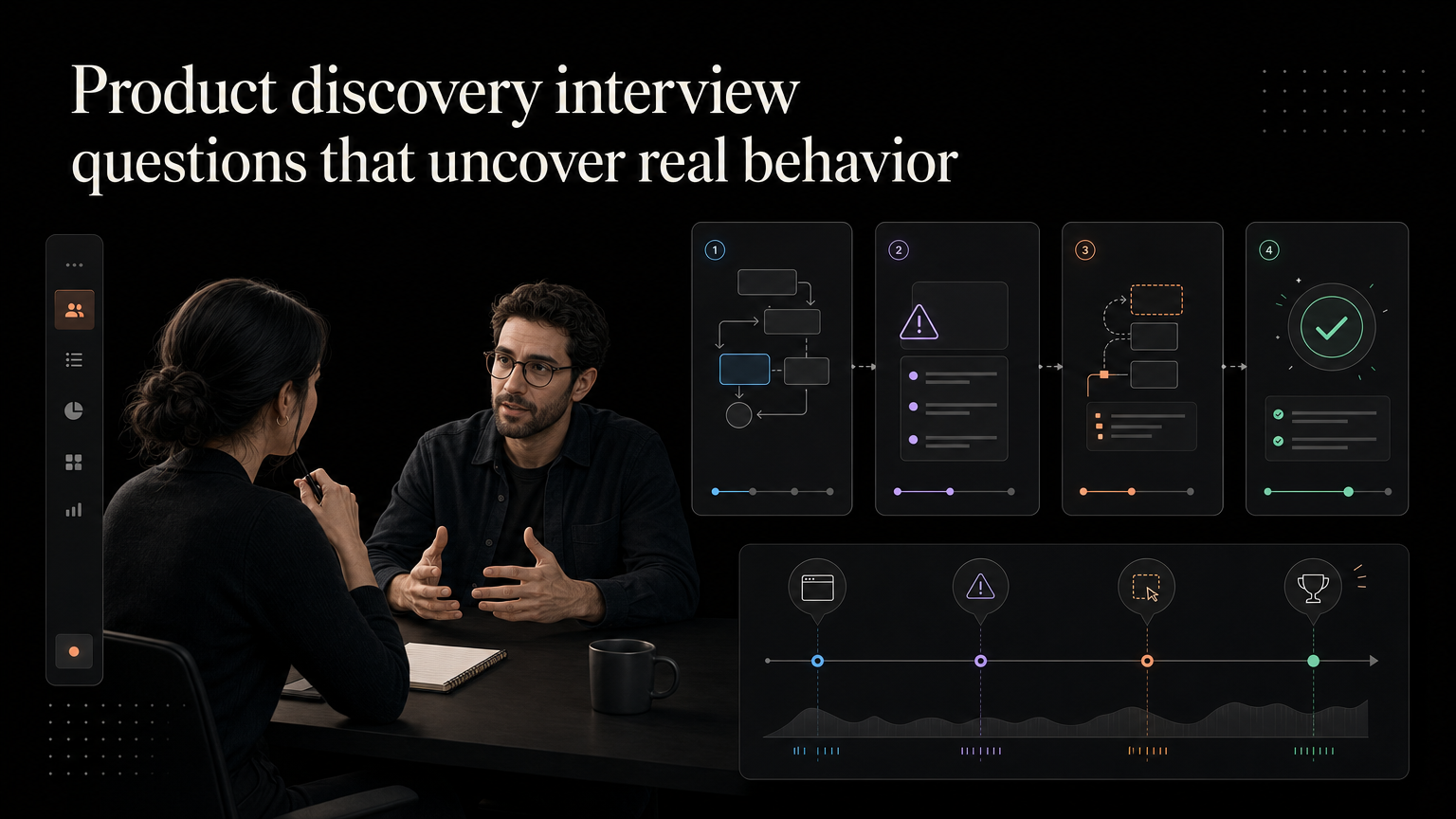
Customer interviews are strongest when they examine something that already happened. Hypothetical questions invite optimistic answers.
Start with the last event
- Tell me about the last time you tried to do this.
- What triggered the task?
- What did you do first?
- Where did you get stuck?
- Who else was involved?
Ask for the sequence. Specific details are more reliable than general opinions.
Understand the consequence
- How often does this happen?
- How much time does it take?
- What happens if it is not completed?
- Which part causes the most risk or frustration?
Examine the workaround
- What do you use today?
- What have you already tried?
- What does the workaround cost?
- Why have you kept it?
- What would make you switch?
A serious workaround is evidence that the problem matters.
Learn how decisions happen
- Who chooses the tool?
- Who approves the purchase?
- What would block adoption?
- Which alternatives are considered?
- When will the team revisit the decision?
Test a concept carefully
After exploring current behavior, show the smallest concept.
- What would you expect to happen here?
- Which part would you use first?
- What is missing for your real workflow?
- What would prevent you from trying this next week?
Avoid “Would you use it?” Ask for a concrete next action such as joining a pilot or sharing sample data.
End with evidence
Record the customer’s words, observed behavior, assumptions confirmed, assumptions weakened, and the next test.
Link the interview to the related feedback theme so it informs a decision rather than disappearing in a notes folder.
Feedboard helps product teams connect customer conversations to requests and roadmap decisions. Organize product feedback with Feedboard.
Prepare an interview guide
Write the learning goal and five core questions. Keep optional probes underneath. Do not script every sentence; the customer’s answer should determine the follow-up.
Recruit people who recently experienced the problem. Memory becomes less reliable as time passes.
Ask for artifacts
When appropriate, ask customers to show the spreadsheet, email, dashboard, or document used in the workaround. Artifacts reveal steps people forget to mention.
Respect confidential data. Let the customer redact details or describe the structure instead.
Separate evidence from interpretation
After the call, record:
Observed behavior:
Direct customer statements:
Current workaround:
Consequence:
Our interpretation:
Open questions:
Next test:
Keeping interpretation separate reduces the chance that a team assumption is later quoted as customer evidence.
Interview mistakes
Avoid pitching too early, defending the current product, asking customers to predict long-term behavior, and treating one conversation as a market.
Do not ask, “Would you pay for this?” Ask how the current problem is funded, who approves purchases, and what commitment the customer can make now.
Synthesize across interviews
Review interviews together and group repeated problems. Note contradictions and segment differences instead of forcing consensus.
An interview program should end with a decision or next experiment, not merely a folder of transcripts.
Recruit for the decision
Choose participants who recently experienced the workflow and represent the intended customer. Include successful and unsuccessful users when investigating adoption.
Do not recruit only the accounts your team knows well. Highly engaged customers may understand the product too deeply to reveal ordinary onboarding problems.
Open the conversation
Explain that you are studying their work, not testing them. Ask permission to record and state who will see the notes.
A useful opening is:
I want to understand how you handle client reports today. I did not design your process, so please correct my assumptions.
Follow the timeline
Ask the customer to walk through events in order:
- What triggered the task?
- What happened first?
- Which tools or people were involved?
- Where did the process slow down?
- How was the result shared?
- What happened afterward?
Timeline questions reveal dependencies that feature-focused questions miss.
Probe without leading
Repeat the customer’s word and ask for detail:
You said the export was painful. What made it painful the last time?
Avoid inserting a diagnosis:
Was it painful because the button was hard to find?
The second question gives the customer an answer to agree with.
Discuss priority through behavior
Ask what the customer fixed first, paid for, escalated, or postponed. These choices show relative importance better than asking them to rank an imaginary feature list.
If they say the problem is critical but have never tried a workaround, explore the contradiction without arguing.
Test concepts after discovery
When showing a prototype, give a realistic task rather than a tour:
You need to send this report to three clients every Monday. Show me what you would do.
Observe where the participant looks and what they expect. Ask for interpretation before explaining the design.
Take useful notes
Tag notes by customer problem and workflow. Link relevant moments to existing feedback themes. Preserve short verbatim phrases only when wording matters and permission allows it.
After each interview, write the strongest evidence against your current assumption. This counters the natural urge to collect confirmation.
Synthesis session
For every repeated theme, record:
- Participants affected
- Recent examples
- Current workaround
- Consequence
- Segment differences
- Contradictory evidence
- Confidence
- Next decision or test
Do not vote on favorite quotes. Review the evidence and its relevance to the research question.
Frequently asked questions
How many interviews are enough?
Interview until the team can make the current decision with acceptable confidence. Five focused conversations may expose usability problems; market decisions usually need broader evidence.
Should multiple teammates attend?
One interviewer and one note-taker works well. Large groups can intimidate participants. Let others watch recordings with permission.
Should customers approve the notes?
You can confirm sensitive or consequential claims. Do not burden every participant with editing a full transcript.
Interview consent checklist
Explain the research purpose, expected duration, recording, note access, incentives, and how quotes may be used. Make declining a recording easy.
Store recordings and transcripts according to a retention policy. Remove credentials, personal data, and customer-confidential material from shared clips.
Observer guidance
Observers should remain quiet, keep cameras and introductions appropriate, and send follow-up questions to the interviewer rather than interrupting.
After the call, observers independently write key evidence before discussing it. This reduces group anchoring on the loudest interpretation.
Research repository fields
Participant and segment:
Research question:
Date:
Recent event:
Observed workflow:
Problem and consequence:
Workaround:
Contradictory evidence:
Linked theme:
Consent restrictions:
Next decision:
Quality review
Audit whether participants matched recruitment criteria, questions remained neutral, notes separate observation from interpretation, and synthesis includes disconfirming evidence.
A polished transcript is not the output. The output is a better product decision with a traceable evidence path.
Close the participant loop
When appropriate, tell participants what the team learned or changed. Do not promise a feature merely because someone joined research.
A short update respects the time they contributed and makes future participation more likely. Keep product-sensitive findings private while sharing the customer-safe outcome.